

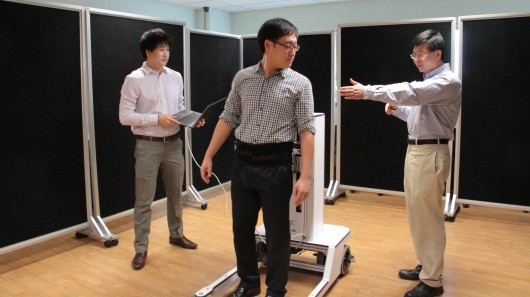
Designed by a team led by Assistant Professor Yu Haoyong, the omni-directional platform supports the patient’s body weight as they walk across the floor, while also providing powered support for movements of their pelvis and trunk. Force sensors detect the direction in which the patient wishes to move, and respond by moving the walker with them in that direction.
It additionally incorporates a network of body-mounted sensors, that it uses to determine the patient’s current gait. In order to correct flaws that it detects within that gait, the walker delivers electrical stimulation to selected muscles, at key points within the stride. Therapists can also set the walker to provide resistive force, to provide patients with resistance training.
While all this is happening, the system collects data regarding the patient’s gait and muscle activation patterns. Therapists can then view that data, to track the patient’s recovery process.
via Gizmag






