

Back in March, we posted about how this could be the year where the National Ignition Facility breaks even with laser fusion, reaching the point where as much power is generated as is input. This doesn’t mean we’ve got a fusion power plant around the corner, though, and researchers have come clean about what the hold-up is.
Fusion power is what you get when you take two lightweight atomic nuclei and fuse them together into one heavier atomic nucleus, releasing energy in the process. It’s far cleaner and far more efficient than fission power, and the only reason that we’re not taking advantage of it right now is that it requires temperatures and pressures on the order of what you’d experience at the center of the sun to get it to work.
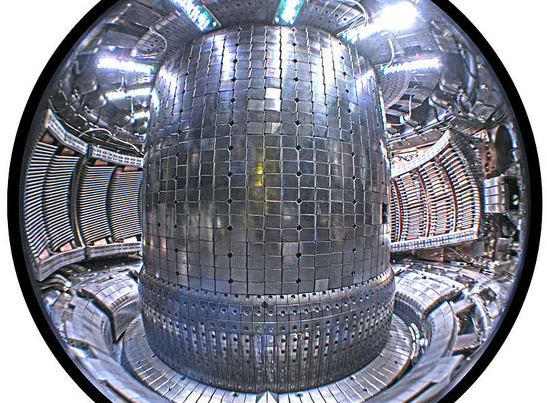
At MIT, they’ve been working on getting fusion to happen inside a Tokamak (called the Alcator C-Mod, pictured above), which is a piece of equipment that uses intense magnetic fields to confine and heat plasma to the point that fusion can be initiated, which is something on the order of tens to hundreds of million of degrees.
via DVICE






