

The Inca Empire covered vast parts of South America, uniting distant cities in Chile, Peru, and even Argentina with well-engineered highways. Sophisticated agricultural systems and architecture allowed the Inca to live on the steep slopes and jagged peaks of mountains. And they did it all without money or markets as we know them. Instead, Inca leaders had an elaborate system of tributes or taxes that took the form of the land’s most precious resource: food.
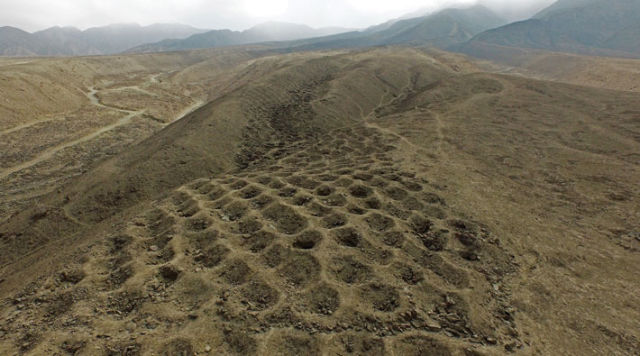
But how do you quantify many different forms of tribute—from squash and rope to corn and peppers—without a system like money to measure exchange value? Perhaps by inventing other systems of measurement. Archaeologists are exploring a mile-long road made entirely of shallow, rock-lined holes that may have once been a dropoff point for Inca food tributes. Dubbed the “Band of Holes,” the road climbs the slope of Peru’s Monte Sierpe, in a region that has been home to complex human settlements for thousands of years. The rock here is so hard that the people who built it did not bother to dig their carefully sized holes (each is about 3 feet wide and 20-40 inches deep); instead, they constructed the nearly 6,000 holes out of soil and fist-sized rocks they brought from elsewhere. Seen from above, the Band of Holes looks like ribbon of precisely placed firepits, or maybe an infinite punchcard.
via Ars Technica






