

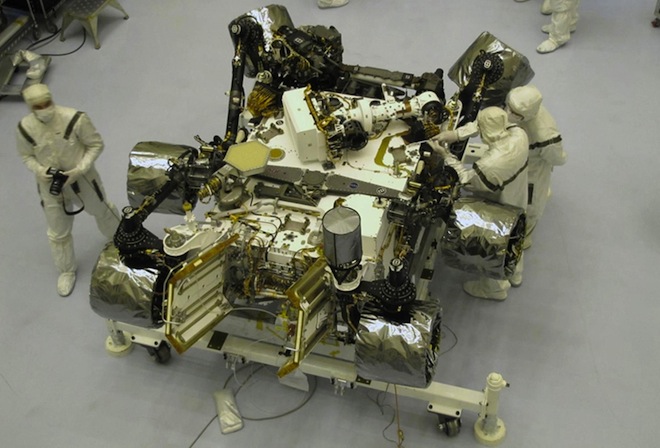
NASA’s Curiosity Rover has had a historic week on the surface of Mars, executing a flawless landing on the Red Planet and firing up for its mission. But under the hood, the interplanetary explorer is powered by a pair of computers built by BAE Systems. They’re called RAD750′s. And it turns out that the radiation hardening that they need to operate on Mars isn’t all that different from the protection that some of today’s largest supercomputers need to keep chugging along.
The RAD750 isn’t much when measured by terrestrial PC metrics. It’s a customized take on a 10-year-old IBM PowerPC chip design, and its 132 MHz clock speed would have been impressive around the time of the Windows 95 launch. It comes with just 120 megabytes of RAM. But like the other electronics components on Curiosity Rover the RAD750 has one thing going for it: It’s tough enough to withstand launch-time shaking, wild temperature fluctuations and levels of ionizing radiation that would fry the machine that you’re using to read this story.
via Wired






