

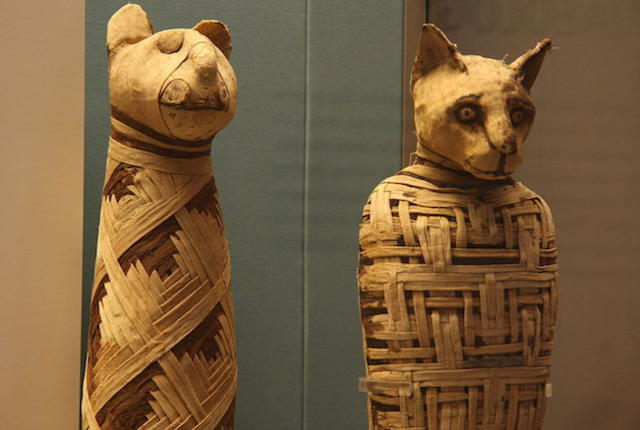
“You would go to a special site, buy an animal mummy, using a system of barter. You’d then give it to a priest, who would collect a group of animal mummies and bury them,” Price explained. But despite a dedicated program of breeding and killing animals specifically for mummification, it was hard to keep up with the demand.
So the mummifiers started cutting corners. Or so it seems, based on new research out of Manchester Museum and the University of Manchester.
Over 800 specimens—ranging from cats and birds to crocodiles—were run through X-rays and CT scans for a project followed by the BBC’s Horizon program. And what they found wasn’t quite what they were expecting.
“There have been some surprises,” said Dr. Lidija McKnight, an Egyptologist from the University of Manchester. About a third of the 800 contained remarkably well-preserved animal mummies, just as the wrappings would have one believe. Another third contained partial remains. And the final third? Nothing much.
via Mental Floss
Image: WIKIMEDIA COMMONS






