

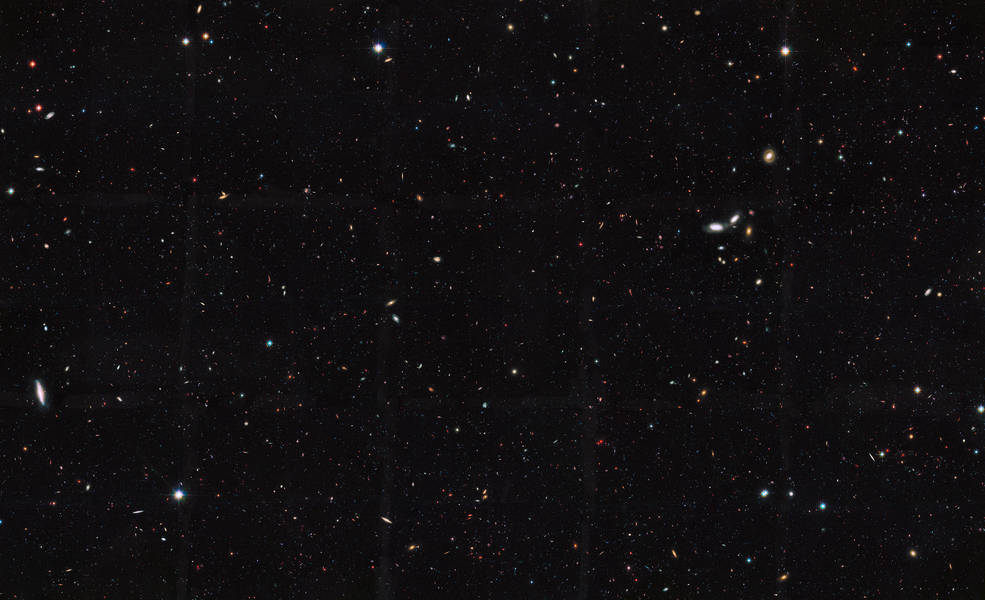
The universe suddenly looks a lot more crowded, thanks to a deep-sky census assembled from surveys taken by NASA’s Hubble Space Telescope and other observatories.
Astronomers came to the surprising conclusion that there are at least 10 times more galaxies in the observable universe than previously thought.
The results have clear implications for galaxy formation, and also helps shed light on an ancient astronomical paradox – why is the sky dark at night?
In analyzing the data, a team led by Christopher Conselice of the University of Nottingham, U.K., found that 10 times as many galaxies were packed into a given volume of space in the early universe than found today. Most of these galaxies were relatively small and faint, with masses similar to those of the satellite galaxies surrounding the Milky Way. As they merged to form larger galaxies the population density of galaxies in space dwindled. This means that galaxies are not evenly distributed throughout the universe’s history, the research team reports in a paper to be published in The Astrophysical Journal.
via NASA






