

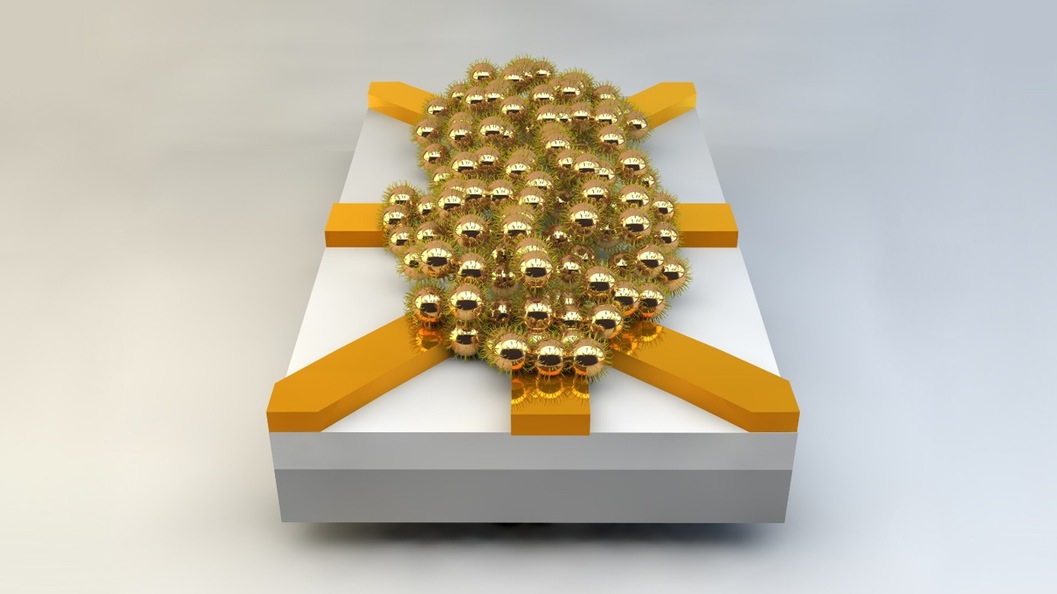
A research team led by professors Wilfried van der Wiel and Hajo Broersma is walking a different path. Remarkably, their device takes people out of the the circuit design equation altogether and leaves it to the chip itself to figure out how to best manipulate its inputs into the desired output through artificial evolution.
Their proof-of-principle device consists of a network of up to 100 densely interconnected gold nanoparticles, 20 nanometers in size, each acting as a tiny transistor. The researchers call it a natural computer, because the way in which the particles are interlinked is reminiscent of neural networks in the brain. Unlike in a standard circuit, the scientists themselves don’t exactly know how the transistors in a natural computer connect with each other – but this doesn’t stop the circuit from working as intended.
via Gizmag
Image: University of Twente






