

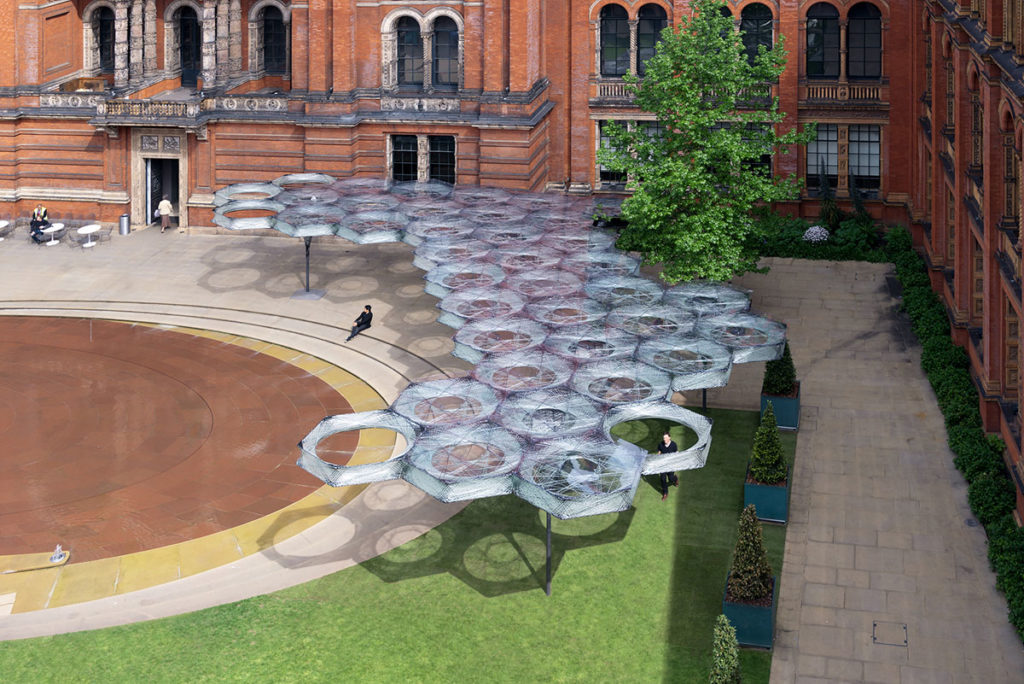
By looks alone, the pavilion is imposing. The structure’s 40 lightweight components cast a wide, geometric shadow across the garden’s expansive lawn. But its engineering is even more impressive. A gigantic robotic arm assembles each hexagonal module out of a double-layered carbon- and glass-fiber web. The modules weigh just 99 pounds apiece, putting the entire structure in the neighborhood of 5,400 pounds—or about the same weight as just 21 square feet of the museum’s stone facade. That makes the Elytra about 100 times lighter, per square foot.
But the pavilion’s first 40 modules were just the first step. “You can think of pavilion as a living experiment, using the garden as a laboratory,” says Achim Menges, director of the Institute for Computational Design in Stuttgart, where the pavilion was born. In the coming months, Menges’ team will add modules that look very different, shaped by two new data inputs: environmental factors like temperature and forces exerted on the pavilion, and the behaviors of people who interact with it.
via Wired






