



When I wrote “The Radio Shack at the End of the Universe” for EEJournal back in 2018, I assumed it described my last visit to a Radio Shack. The number of Radio Shack stores had crashed following two corporate bankruptcies. All the corporate-owned stores had been closed and the real estate sold off. What remained was a dwindling collection of dealers and affiliate stores, like the TV and radio repair shop named Crystal TV, located in Hollister, Colorado, which my wife and I had visited back in 2018 when we lived in San Jose, California. However, Radio Shack has somehow managed to survive, despite the odds. After passing through the hands of several owners, Unicomer Group, a multinational retailer and consumer finance company based in El Salvador, bought the RadioShack brand (with no intervening space between “Radio” and “Shack”) and the company’s intellectual property back in 2023, and relaunched the company.
Previously, Unicomer operated Radio Shack stores in El Salvador, Honduras, Guatemala, and Nicaragua. By January 2015, the year of Radio Shack’s first bankruptcy, Unicomer had 57 Radio Shack stores in South and Central America and the Caribbean. According to Wikipedia, by the end of 2017, the year of Radio Shack’s second bankruptcy, Unicomer had company-owned stores located in Barbados, El Salvador, Guatemala, Guyana, Honduras, Jamaica, Nicaragua, and Trinidad while receiving franchise payments from independent franchised stores located in the countries of Antigua, Aruba, Costa Rica, Paraguay and Peru. After acquiring all Radio Shack IP assets in 2023, Unicomer has slowly rebuilt the RadioShack.com corporate Web site, and you can currently buy RadioShack-branded consumer electronics products such as headphones, desk clocks, and cellphone accessories (but no electronic components) online.
You can find surviving US Radio Shack stores with a handy locator map on the RadioShack.com site. I now live in Utah, and, to my surprise, two Radio Shack stores survive in the state. Both stores are listed as authorized resellers. One of the remaining stores is located on Main Street in Moab. I visited that store, Royce’s Electronics, a couple of years ago, but the store was not open on the day I visited.
The other Utah Radio Shack affiliate store is located in the small town of Panguitch. It’s located inside the Panguitch Drug Company. This store combines an independent pharmacy, a “Cowboy Store” that sells sporting goods and ranch wear including Carhartt clothing, a gift shop that sells trinkets and holiday ornaments to the tourist trade, and a surprisingly well-stocked Radio Shack.
There was ample online evidence that the Radio Shack nook in Panguitch Drug was still open for business. Recent online photos of the store suggested that it was still stocked with the usual Radio Shack items including a tall stack of metal drawers containing Radio Shack electronic components. Panguitch Drug is only a 2.5-hour drive from my home near St. George, so on a mid-July Saturday, my wife and I gassed up the Camry Hybrid and set out for Panguitch.
A drug store may seem to be an odd host for a Radio Shack affiliate, but I’ve seen the like before. When I graduated from Case Western Reserve University fifty years ago and moved to Loveland, Colorado to work for HP’s Calculator Products Division, I found a Radio Shack located in the lobby of a motel along Loveland’s main drag, Eisenhower Blvd. You could check into the motel and buy a few ICs at the same time. That Radio Shack is long gone, and so is the motel. So is the HP division where I once worked.
Back then, Loveland was a small agricultural and retirement community that also served as a gateway to Rocky Mountain National Park. Sugar beets were the town’s primary product, and HP’s desktop calculators and computers were a distant second. Like Loveland, Panguitch is also a small agricultural community. We saw plenty of grazing cattle herds on our way into Panguitch. According to the Utah Geological Survey, the town of Panguitch is located in Sevier Valley, a beautiful high-mountain vale situated in Utah’s Southern High Plateaus. The town serves as a gateway to Bryce Canyon and Capitol Reef, two incredibly grand parks in the US National Park collection.
We approached Panguitch from the north on US Route 89 after circling back from I-15. Panguitch Drug is in the center of town, so we drove down the town’s main street to reach our destination. A left turn from Main Street onto Center Street brought us to Panguitch Drug. Here’s a photo of the store:
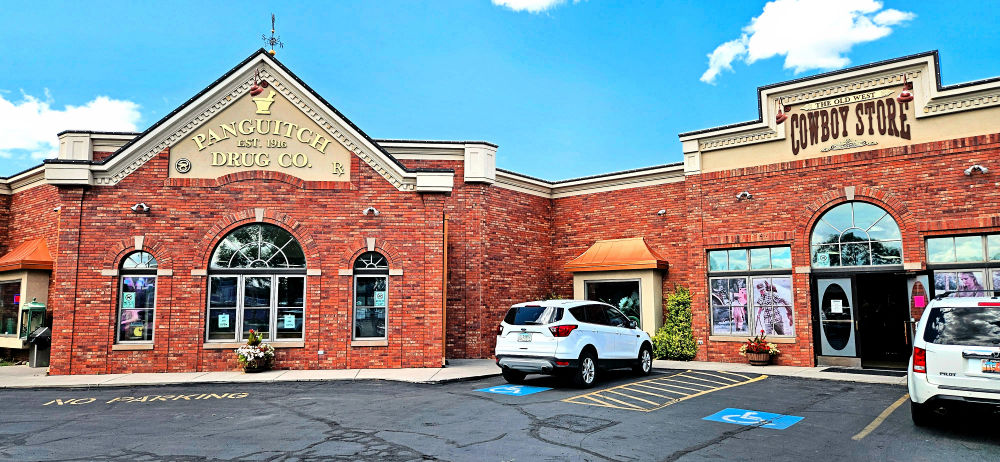
Panguitch Drug Store in downtown Panguitch, Utah. Image credit: Steve Leibson
Panguitch Drug has been in business for more than a century. Earl Marshall started the business in January 1916 and bought out his competitor a few years later. The business has stayed in the family for four generations. For decades, Panguitch Drug occupied a location on the town’s Main Street. The store moved to its current location in 1998.
Online, I found a decade-old photo of the store’s sign that perfectly encapsulates the eclectic nature of Panguitch Drug, showing the pharmacy’s past affiliation with the Rexall Drug Store chain, the Radio Shack connection, the cowboy store, and a monument to the LDS Church building that formerly occupied the site until 1949. Today, an electronic billboard sign has replaced the Radio Shack portion of the sign:
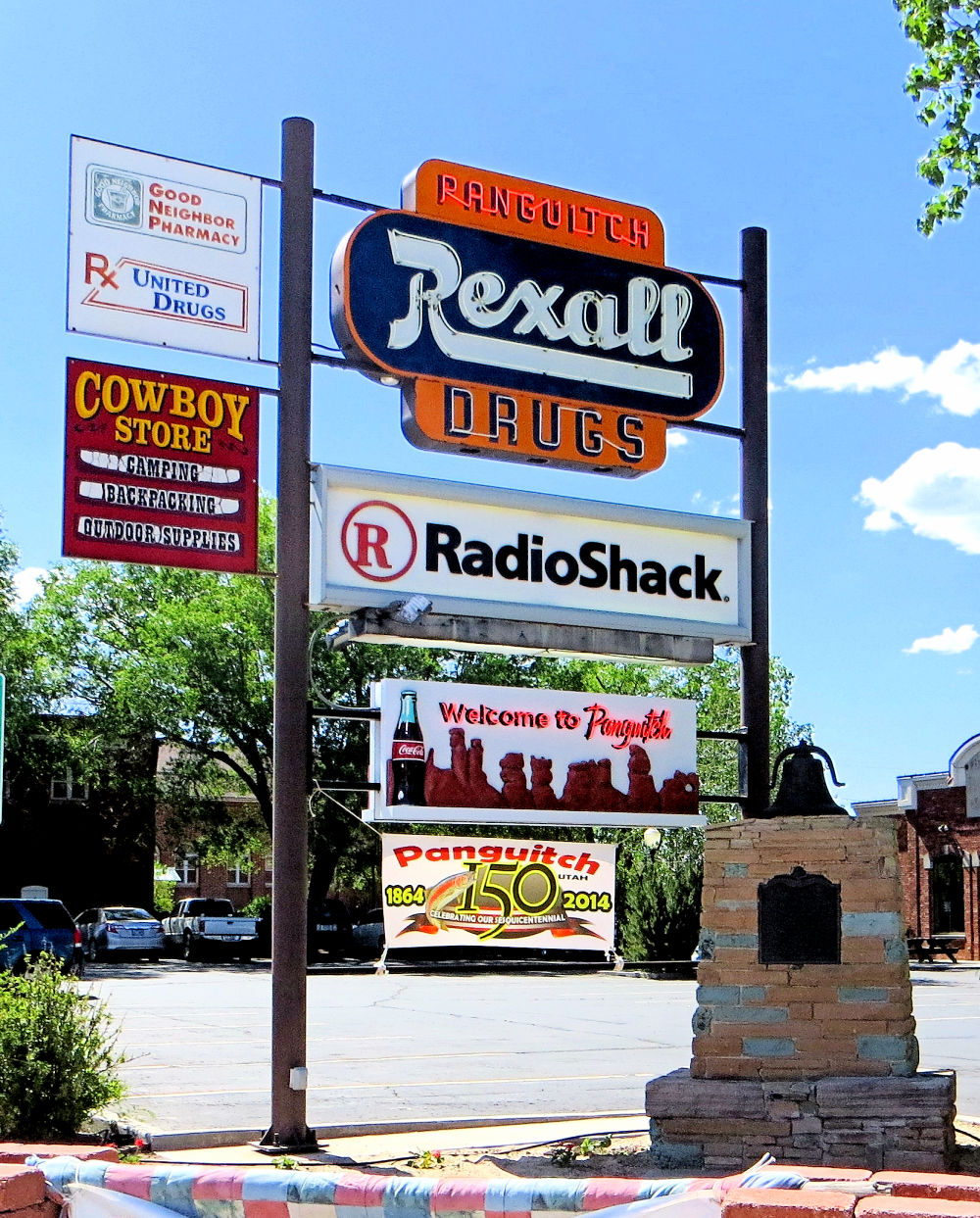
This photo of the Panguitch Drug Store sign from 2014 perfectly encapsulates the eclectic nature of the store, showing the pharmacy’s past affiliation with the Rexall Drug Store chain, the Radio Shack connection, the cowboy store, and a monument to an LDS Church building that formerly occupied the site until 1949. Today, an electronic billboard sign has replaced the Radio Shack sign. Image credit: Bill Kirchner
We entered the store through the door labeled “The Old West Cowboy Store.” Inside, the building is one large store divided into several sections like a department store. The cowboy store has a large hat selection, assorted clothing, and some sporting goods. Looking through to the rest of the store, the Radio Shack component was nowhere to be seen. I felt a bit let down, but I spotted the Radio Shack nook off to my right as soon as I exited the cowboy store section through a connecting doorway. It was impossible to miss:
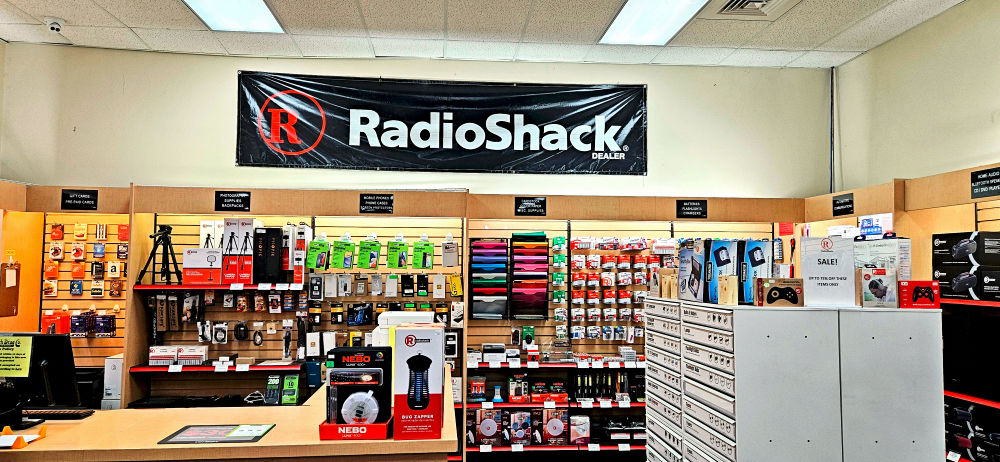
Radio Shack nook at Panguitch Drug Store. Image credit: Steve Leibson
I made a beeline for the Radio Shack nook and was immediately transported back in time by a decade or two. There were the familiar pegboard items on the well-stocked walls. Close inspection showed that there were even a couple of different pc prototyping boards still hanging on wall pegs. The nook’s back wall was filled with Radio Shack branded batteries. I saw soldering equipment on the shelves, and there was a small section devoted to cellphone accessories. Cellphones and associated accessories were Radio Shack’s last gasp attempt to maintain relevance in the transformed world of consumer electronics during the 2000s and 2010s. The Panguitch store has a complete set of metal electronic component bins, which supplanted the pegboard hangers starting around the turn of the millennium.
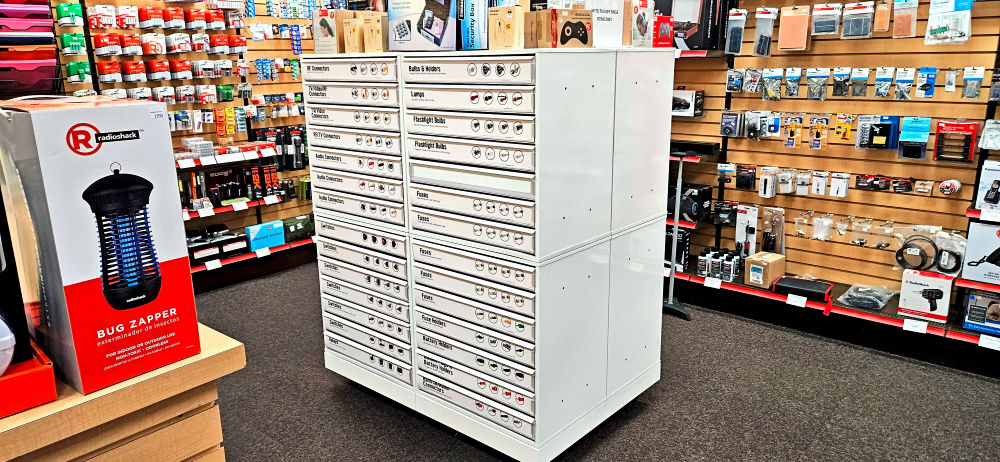
Component bins at the Radio Shack nook in the Panguitch Drug Store. You can see a couple of pc boards for electronic prototyping intermixed with solar cells hanging on the wall in the upper right corner of the photo. Image credit: Steve Leibson
I opened every drawer of the component bin display during our visit. There were plenty of components sitting in their little compartments, although the stock clearly had not been replenished for many years. Many of the compartments were empty. The stock of switches seemed particularly sparse, but there were plenty of cardboard packages holding five tiny 1/8W resistors per package. So nostalgic! I wasn’t going to leave without buying something, so I found a pack of ¾” hexagonal control knobs for $2.99 and a package of two metal, panel-mount LED bezels for $1.69. Prices clearly hadn’t been updated for a decade or more. My purchase came to a paltry $5.07 with tax.
Sam Marshall, the fourth family member to become the store’s pharmacist, told me that Panguitch Drug became a Radio Shack dealer “around 1998.” That would be the same year that the company moved into its Center Street location. After a few years hiatus, Panguitch Drug can once again order Radio Shack products through a wholesale portal, but they can no longer place orders for electronic components.
When I checked recently, Radio Shack’s site listed 85 authorized resellers in the US including Panguitch Drug. That number’s down substantially from a peak of 8000 stores around the turn of the millennium. The 1981 Radio Shack catalog, published when the Radio Shack was 60 years old, claimed that nine out of ten Americans lived within 5 miles of a Radio Shack. Back then, the company had 6000 stores. (If you’re into looking at old Radio Shack catalogs, you’ll find online scans of catalogs from 1939 to 2002, the company’s last printed retail catalog, at https://www.radioshackcatalogs.com. I have a dogeared paper copy of that catalog.)
Radio Shack cut a deal with HobbyTown in 2018 that made dealers out of all HobbyTown stores. The HobbyTown website still lists more than 100 Radio Shack component products, but given what I’ve just learned, you may be hard pressed to buy components using that route. I checked in-store electronic component availability of my local HobbyTown store, and I’d say availability is sparse, at best. The Radio Shack components on the HobbyTown website all appeared to be labeled “in store only,” and I didn’t find any electronic components in stock locally.
These days, I don’t think Radio Shack’s nostalgic component bins are very relevant, thanks partly to Amazon. A package of ten knobs like the ones I bought in Panguitch costs $10 at Amazon, with free shipping for Prime members. A package of 20 metal LED bezels like the ones I bought in Panguitch costs $6.29 from Amazon, again with free shipping for Prime members. Recently, when I needed a BT151 SCR in a TO-220 package to repair the crowbar circuit of a Sola 5V linear power supply that I’d purchased on eBay, it was easy to find an exact replacement on Amazon. A package of ten replacement SCRs cost $6.99. At least, I think these SCRs are an exact replacement. The power supply’s dead SCR was made by Philips. The newly acquired SCRs are branded NXP. Philips Semiconductors spun out of Philips Electronics and changed its name to NXP in 2006. It absorbed Motorola/Freescale Semiconductor in 2015.
Electronic component availability on Amazon simply amazes me, with the caveat that you’re never entirely certain about the provenance of the components on offer, so you should use more traditional component distributors (Arrow, Avnet, Digikey, Element14/Farnell, Mouser, Newark, etc.) for production. For knobs and bezels, I don’t think it matters.
Two items I’d hoped to find on our trip to the Radio Shack in Panguitch were power transformers and metal project enclosures. Panguitch Drug stocked neither of these Radio Shack products when we visited, but that wasn’t a surprise considering that these items haven’t been available at a Radio Shack for more than a decade. These days, I buy previously owned but unused copies of these products on eBay.
Hopping on the Internet the day after our trip, I found that Amazon’s selection of transformers and enclosures also leaves much to be desired, but Jameco, a mail-order and online supplier of electronic components that I’ve used for nearly 50 years, has an ample stock of both power transformers and metal enclosures in its ValuePro line, listed at very low prices. They’re just a bit hard to find using the company’s rather simple online search tools unless you know the exact name for the item you want.
I don’t think Radio Shack will ever be a component supplier again, nor do I think that Unicomer wants to restart the components side of the Radio Shack business. The hardware hobbyist situation has changed from the times when you could pop into your local neighborhood Radio Shack for a quick component fix. Now we have the Internet. Now we have Amazon, eBay, Adafruit, and Sparkfun. “The times, they are a-changing,” sang Bob Dylan.
My connection with Radio Shack started in the late 1960s, when you could buy surplus IBM SMS computer boards with the edge connectors broken off. I salvaged many electronic components from those boards and never used any of them, but the exercise built my soldering skills. Early on, I also built several of Radio Shack’s “P Box” solderless electronic projects, and I worked as a repair tech one summer in another local Radio Shack, although business was so slow out in the exurbs that the store manager and I mostly played chess. What’s your favorite Radio Shack story?







Hi Steve – great to see your byline! Stop by more often.