




Apropos of nothing at all, I just read a definition of “engineer” that struck a chord. I understand that this was one of five options submitted to EE Times by their readers many moons ago. The definition in question reads as follows: “An engineer is someone who takes the creativity of an artist, the knowledge of a scientist, the imagination of a writer, and the stamina of an athlete and turns science fiction into reality.” I couldn’t have said it better myself.
But we digress… I was just chatting with Piyush Sevalia, who is Executive Vice President of Marketing at SiTime. Piyush was bringing me up to date with the latest “hot off the press” news that SiTime has just entered the standalone MEMS resonator market.
As you can imagine, this was something of a surprise to me—the main surprise being that I’ve been laboring under the misapprehension that SiTime was already a dominant force in the MEMS resonator market.
Silly me. I shall have to chastise myself soundly. It turns out that my confusion was caused by the fact that, although the guys and gals at SiTime have been famously fabricating MEMS resonators for use in their own products for yonks and yonks (that’s a lot of yonks), they haven’t made these resonators available as standalone offerings… until now.
This is one of those interesting technological areas that we all think we understand… right up until we are asked to explain it to someone else. As Saint Augustine of Hippo (354–430 AD) famously said while reflecting on the mystery of time in his Confessions (Book XI): “What then is time? If no one asks me, I know: if I wish to explain it to one that asketh, I know not.”
I know how Saint Augustine felt. I previously discussed some of this in my It’s Time to Learn More About Timing column, but I feel it’s worth expounding on it again.
As a starting point, let’s remind ourselves that precise timing is the invisible heartbeat of modern electronics. Almost every aspect of our digital lives depends on signals that remain synchronized to an extraordinary degree of accuracy. Strip away reliable timing references, and the everyday systems we count on—including cloud data centers, connected cars, mobile devices, and wearables—would tumble into chaos, unable to function as intended.
There are countless ways to keep track of time, ranging from simple pendulums to mind-bogglingly complex atomic clocks that define the international standard of a second. However, in the real world of everyday electronics, the unsung heroes of time are the humble oscillators that provide the steady “ticks” that keep our devices synchronized and our systems running smoothly.
If the oscillator is the heartbeat of electronics, then the resonator is the heart of the oscillator—the part that sets the rhythm while the supporting circuitry keeps it alive. We can think of the resonator as the “tuning fork” inside the oscillator. It’s the part that decides which note gets played, while the electronics surrounding it keep the music going.
To put this another way, a resonator is a passive device that vibrates at a fixed frequency, while an oscillator is an active device that uses a resonator and an oscillation circuit to generate a clock signal.
In the early days of electronics, quartz became the standard resonator material due to its piezoelectric effect, which made it ideal for stable electromechanical oscillation. It also didn’t hurt that quartz was abundant and inexpensive. The abbreviation for this type of crystal resonator is X or XTAL.
The first quartz crystal oscillator (XO) was built in 1921 by American physicist and electrical engineer Walter Guyton Cady. By the late 1920s, quartz oscillators were being used in radio transmitters to stabilize frequencies. During World War II, they became widespread in military radios, radars, and navigation systems. From the 1950s onward, they migrated into consumer electronics, eventually becoming the de facto standard for timing.
MEMS (micro-electromechanical systems)-based resonators are more recent. Around 2008–2010, companies like SiTime began shipping MEMS oscillators that could compete with quartz in mainstream applications. Today, MEMS resonators are mature, offering advantages in ruggedness, integration, programmability, and supply chain independence (no quartz mining).
Speaking of oscillators, these come in a mindboggling assortment of flavors. The main families include the following: standard crystal oscillator (XO), voltage-controlled crystal oscillator (VCXO), temperature-compensated crystal oscillator (TCXO), oven-controlled crystal oscillator (OCXO), double oven-controlled crystal oscillator (DOCXO), voltage-controlled temperature-compensated crystal oscillator (VCTCXO), voltage-controlled oven-controlled crystal oscillator (VCOCXO), microcomputer-compensated crystal oscillator (MCXO or MXO), and… then things start to get complicated.
The tricky thing here is that, although the ‘X’ in “X” and “XO” originally stood for “crystal,” the industry has kept the same shorthand even as new technologies emerged. Today, those same terms are used just as readily to describe MEMS resonators and MEMS-based oscillators.
What I hadn’t realized is that standalone quartz resonators are one of the most common timing elements you’ll see on a printed circuit board (PCB). Many devices—MCUs, SoCs, wireless ICs—are designed to work with a bare quartz resonator (X) on the board. In this case, the chip contains the oscillator circuit, and the designer simply adds a resonator along with a couple of capacitors. This is a more cost-effective and space-saving alternative to having a full crystal oscillator (XO) on the board.
This is where SiTime’s new Titan MEMS resonators come into play. These offer many advantages compared to quartz, including mechanical robustness, environmental resilience, higher reliability, longer lifetime, programmability, and flexibility. Another big standout is that MEMS resonators are significantly smaller and lighter than their quartz counterparts. How small? I’m glad you asked. We’re talking less than 0.5 x 0.5 mm, which is a fraction of the size of a quartz counterpart.
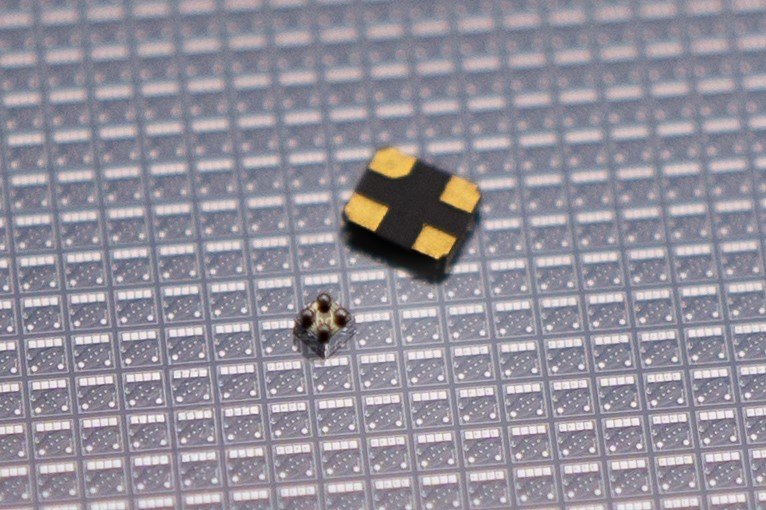
A Titan MEMS resonator (lower left) is much smaller than a quartz resonator (Source: SiTime)
This means that the Titan consumes 7X less PCB real estate compared to a 1210-size quartz crystal. Samples of 32MHz Titans are available as I pen these words (this is the frequency commonly used to provide the reference clock for 32-bit MCUs and Bluetooth chipsets), with 38.4, 40, 48, and 76.8MHz samples becoming available in 4Q2025.
Also of interest for designers wishing to dip their toes in the MEMS resonator waters, the chaps and chapesses at SiTime offer the smallest evaluation board I’ve ever seen. The SiT6400EB is only 1.0mm x 1.2mm. This allows users to swap out an existing quartz resonator with a Titan to contrast and compare the two devices.
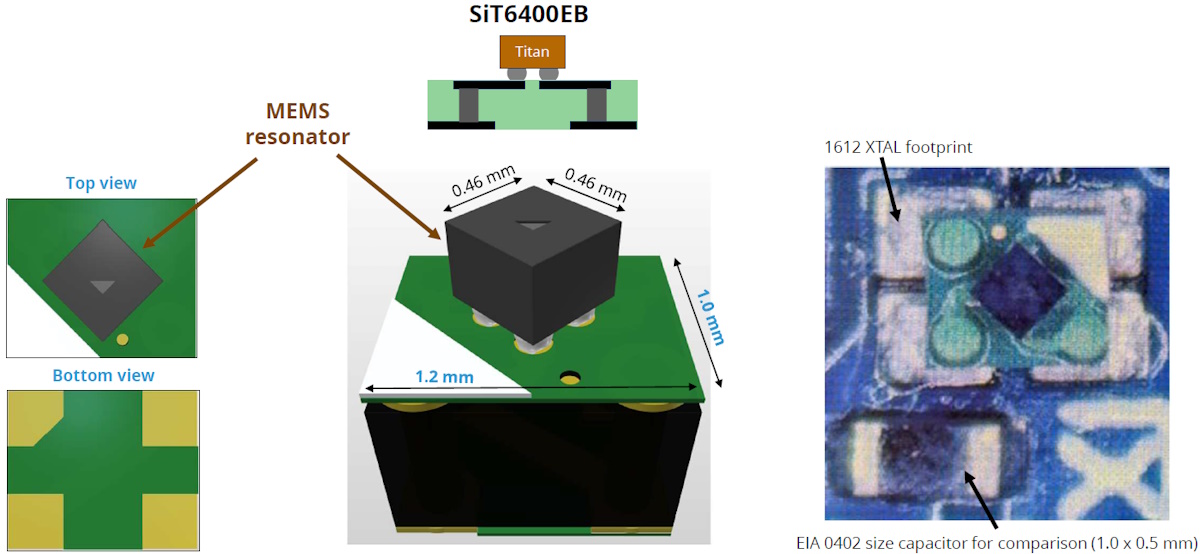
SiT6400EB evaluation board (Source: SiTime)
But wait, there’s more. One of the reasons the designers of devices like MCUs and SoCs mount their resonators outside the package on the PCB is that quartz resonators in ceramic packages do not easily integrate inside the MCU/SoC’s plastic-molded System-in-Package (SiP). By comparison, a Titan in its 0.46mm x 0.46mm chip scale package (CSP) is more than amenable to being co-packaged with the main MCU/SoC die (it can be die-attached and wire-bonded, or bumped, like any standard silicon die).
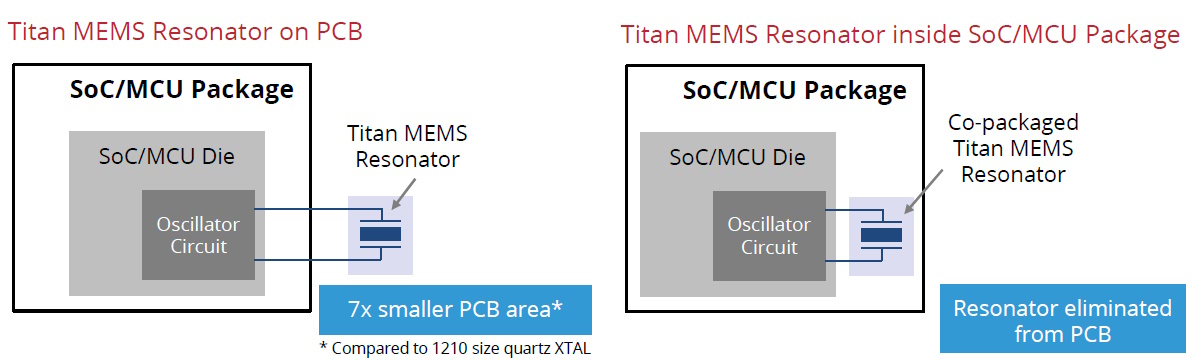
Eliminating the resonator from the PCB completely (Source: SiTime)
In addition to freeing up two more valuable GPIO pins on the main package, the result of co-packaging the Titan MEMS resonator is 3X faster startup and up to 50% lower oscillator power.
The Titan fully addresses the demands of a tremendous range of target applications involving space-constrained, battery-operated, connected devices. These include wearables (smartwatches, fitness bands, rings, sleep trackers, smart eyewear…), medical devices (hearing aids, continuous glucose monitors, biosensors, implantable devices…), and smart home and industrial IoT (sensors, asset trackers, cameras…).
With the addition of Titan, the folks at SiTime now span the entire gamut of timing products, including software, oscillators, clock chips, and resonators. I look forward to seeing what the little scamps come up with next. How about you? Do you have any thoughts you’d care to share with the rest of us?







What is the overall Height of the resonator?
I don’t know — I’ll ask the folks from SiTime to respond to your question.
I passed your question on to SiTime. I just heard from Eric Garlepp, Sr. Director of Product Marketing | IoT, Mobile & Consumer. Eric says:
“For our current standard CSP package, the nominal height is 0.46mm and the max height is 0.5mm. For co-packaging with other chips, we sell wafers (Known Good Die), offering flexibility to procure much thinner devices for both wire-bonding and bump/flip attach methods. The final choice is determined in conjunction with the specific SoC/MCU company.
A friend we’ll call Adam (because that’s his name) asked me: “Do these resonators still need the capacitive loading, or can that come off the board too?”
I asked Eric at SiTime, who responded as follows: “The load capacitances are on-chip in 90% + of wireless SoCs and 32-bit ARM Cortex M class MCUs that have been launched in the past 4-5 years. That means only the resonator is on the board outside the processor itself. In exception cases where the MCU still requires off-chip load cap’s, the fact that Titan has some amount of internal load caps as part of its native structure means there’s a high chance those external load caps can be completely eliminated. In this case, Titan delivers even more PCB area savings to the end customer. For example, the 7x smaller PCB area (vs 1210 size quartz) can become ~ 10x, depending on the body size of those 2 load caps.”