feature article archive
Subscribe Now

Polish Logic Meets Silicon Magic: Say Hi to Grinn’s GenioSOM-700

The purpose of this column is to waffle (as is my wont) about some super System-on-Module (SOM) units that recently leaped onto the center of the stage with a fanfare of flügelhorns (once heard, never forgotten), but first…

As usual, my poor old noggin is raucously reverberating with new nuggets of knowledge and tempting tidbits of trivia. I know from experience that the only way for me to quieten down inside my head so I can think about the things I should be thinking about is to share my newfound news with … Read More → "Polish Logic Meets Silicon Magic: Say Hi to Grinn’s GenioSOM-700"

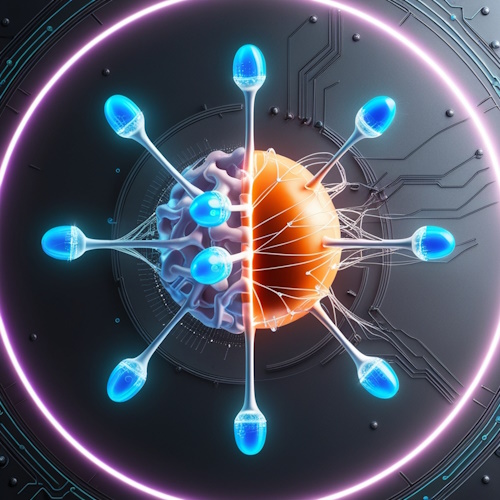
Bodacious Buzz on the Brain-Boggling Neuromorphic Brain Chip Battlefront

Hold onto your hippocampus because the latest neuromorphic marvels are firing on all synapses. To ensure we’re all tap-dancing to the same skirl of the bagpipes, let’s remind ourselves that the term “neuromorphic” is a portmanteau that combines the Greek words “neuro” (relating to nerves or the brain) and “morphic” (relating to form or structure).

Thus, “neuromorphic” literally means “in the form of the brain.” In turn, “neuromorphic computing” refers to electronic systems inspired by the human brain’s functioning. Instead of processing data step-by-step, like traditional computers, neuromorphic chips attempt … Read More → "Bodacious Buzz on the Brain-Boggling Neuromorphic Brain Chip Battlefront"

Edge AI Inferencing 5X Faster with 1/2 the Memory (What’s Not to Love?)

There’s an old joke that I remember from when I was a kid. It started when my dad asked, “When is a door not a door?” I looked at him blankly (a look I’ve since perfected over the years) until he came up with the punchline, “When it’s ajar,” at which point he would convulse in mirth. Well, I have one for you, which goes, “When is a kernel not a kernel?”

I will present the answer to this poser in a moment, alongside some really exciting news pertaining to … Read More → "Edge AI Inferencing 5X Faster with 1/2 the Memory (What’s Not to Love?)"

Agentic AI Prevents Costly Machine Downtime in Factories and Semiconductor Fabs

Things are moving fast in AI space (where no one can hear you scream). For example, I first became aware of the concept of “Agentic AI” only a couple of months ago as I pen these words. Now, I find that this bodacious beauty is already being deployed in factories and semiconductor fabs to transform manufacturing and prevent costly machine downtimes. I tell you, I’m too young for all this excitement.

Before we plunge into the fray with gusto, abandon, and—of course—aplomb, let’s first take a moment to ensure … Read More → "Agentic AI Prevents Costly Machine Downtime in Factories and Semiconductor Fabs"

Are We Ready for 2Q 21C?

It just struck me that we are rapidly approaching the end of 2025. In turn, this means we’re poised to plunge headfirst into 2Q 21C, which is a notation I’ve just invented to indicate “The second quarter of the 21st century.” Feel free to share this nugget of knowledge and tidbit of trivia with your family and friends (you’re welcome).

As I’ve mentioned before, I graduated from high school in 1975. Now, 50 years later, those days make fleeting appearances in the rearview mirror of my life—close enough to touch in … Read More → "Are We Ready for 2Q 21C?"

New Auto Test Capability for the Analog Portions of SoCs

Ever since I began my career in electronics, analog has been the underdog compared to digital in the realm of automation. In the case of tools and techniques like fault simulation, test coverage, and automatic test pattern generation, the digital world has enjoyed robust support for decades. Meanwhile, analog has typically been relegated to handcrafted efforts and ad-hoc methods. Well, that imbalance just shifted in a dramatic fashion.

Analog and digital designers and verification engineers talk different languages and are invited to different parties. This column is unusual in that it should interest … Read More → "New Auto Test Capability for the Analog Portions of SoCs"

SiTime Has Unleashed its Titan MEMS Resonators (Be Afraid, Be Very Afraid)

Apropos of nothing at all, I just read a definition of “engineer” that struck a chord. I understand that this was one of five options submitted to EE Times by their readers many moons ago. The definition in question reads as follows: “An engineer is someone who takes the creativity of an artist, the knowledge of a scientist, the imagination of a writer, and the stamina of an athlete and turns science fiction into reality.” I couldn’t have said it better myself.

But we digress… I was just chatting with Piyush Sevalia, … Read More → "SiTime Has Unleashed its Titan MEMS Resonators (Be Afraid, Be Very Afraid)"

FPGAs Find Their Voice: Achronix and the Economics of Speech Recognition

Speech recognition has become one of the most pervasive AI applications. It’s in our phones, our cars, our call centers—everywhere we need a fast, natural human–machine interface. Training the models that make this work is a cloud-scale GPU problem, but running those models in production—day in and day out—is all about inference. That’s where the economics start to matter.

Inference for speech recognition is both throughput-driven and latency-sensitive. You need to process a flood of audio streams in real time, with each response delivered … Read More → "FPGAs Find Their Voice: Achronix and the Economics of Speech Recognition"

Smarter Human Machine Interfaces at the Edge

I don’t know about you, but it seems to me that breathless commentators, marketing messengers, press release pundits, headline and hype merchants, and technology evangelists are constantly bombarding us with claims and commentaries telling us how lucky we are to be surrounded by technologies that would have been beyond our wildest dreams just a few short years ago.

If we aren’t careful, we might be beguiled into thinking that we are living in a golden age of technology. But is this really the case, or are we collectively trying to convince … Read More → "Smarter Human Machine Interfaces at the Edge"

featured blogs
Jan 29, 2026
Most of the materials you read and see about gyroscopic precession explain WHAT happens, not WHY it happens....