




In a moment, I’m going to tell you about the slightest and slimmest Ethernet switches and routers you’ve never seen, but first… I’ve told this networking narrative before, and doubtless I’ll tell it again (it’s too good to waste). I graduated with my degree in Control Engineering in the summer of I980. My first position was in a team designing CPUs for mainframe computers at International Computers Limited (ICL) in West Gorton, Manchester, UK.
The tale I’m about to tell took place somewhere around the end of 1980 or the beginning of 1981. These days, many people think that PCs (personal computers) in the business sense of the word didn’t appear on the scene until the first IBM PC made its public debut in August 1981. However, there were, in fact, several small desktop computers around at that time. I don’t recall any specific brands, but we’re talking about 8-bit microprocessors running at a few MHz with around 32 to 64KB of RAM and one or two floppy disks… if you were lucky.
One fateful day, our team was instructed to report to one of the big meeting rooms. This was such an important occasion that sandwiches were served—the posh ones with the crusts cut off—even to the likes of your humble narrator (you’ll have to go a long way to out-humble me).
There was a small stage with a PC on a desk and a terminal connected to a mainframe. A proprietary network linked the two machines. At the appointed hour, following an overlong speech by someone or other about something or other, a technician dramatically created and saved a text file using the terminal connected to the mainframe. Next… and this is the good bit… he used the PC to access and modify the same file over the network.
The crowd gasped (apart from me, but only because I had a mouthful—by which I mean a mouth full—of sandwich), ladies swooned, and the more excitable chaps amongst our number clutched their slide rules in disbelief.
Maybe you think I’m being overly dramatic. I’m not. It’s necessary to remember that, circa 1980, the computing landscape was profoundly fragmented. Each manufacturer built its own hardware architecture, bus system, operating system, and even data formats. Compatibility simply wasn’t a design goal at that time, leaving every system as an island unto itself.
“But what about ASCII?” I hear you cry. Well, even though ASCII was created in the 1960s, its use wasn’t universal—IBM used EBCDIC, while others implemented their own partial or extended ASCII sets. Just to add to the fun and frivolity, line endings, word sizes, and byte order (endianness) varied. As a result, even a simple text file could end up as gibberish when migrating between systems.
Believe it or not, even different families from the same manufacturer often couldn’t talk to each other. In the case of IBM, for example, the underlying meaning of EBCDIC—Extended Binary Coded Decimal Interchange Code—was a bit of a laugh. Different IBM computer families used different versions of EBCDIC, thereby rendering the “Interchange” portion of the moniker somewhat mute.
But we digress… As I recall, the aforementioned demo was considered to be so revolutionary that some of the UK’s national newspapers sent their technical reporters by train from London to attend and report on the significance of the occasion (which would certainly explain the presence of the posh sandwiches).
By 1980, nearly every major computer manufacturer was developing (or was already selling) its own proprietary networking architecture, designed to link only its own machines and peripherals. For example, IBM had its Systems Network Architecture (SNA), DEC had DECNet, ICL had DRX/ICLNET, HP had HP-IL/HP-IB, Xerox had XNS, and everyone else had “something of their own.” True interoperability was still but a pipedream.
Today, we live in a world of wired and wireless networks. For wired networks, Ethernet is both the unofficial de facto standard and the official de jure standard, as defined by IEEE 802.3, for nearly all local area networks (LANs) worldwide. However, even though Ethernet was conceived in the early 1970s, its real breakthrough didn’t come until the mid-1980s, when it, and TCP/IP, became widely adopted as open, vendor-neutral standards, largely thanks to the influence of ARPANET and UNIX-based networking.
Since those heady days, Ethernet has evolved in leaps and bounds, becoming truly ubiquitous in the process. What began as a local-area curiosity at Xerox PARC now threads through our homes, factories, cars, aircraft (both manned and unmanned), submersibles (both manned and unmanned), and even spacecraft. It’s the quiet connective tissue of the modern world—linking everything from smart lightbulbs to lunar landers.
One example of Ethernet’s versatility that I happen to know firsthand involved more than 10,000 strain gauges, which were used in the structural verification of a new aircraft wing. These sensors were grouped into sets of sixteen, with each set connected to its own data acquisition module. These modules delivered their measurements to the central computing system over a hierarchical tree of standard Ethernet links. Power for the instruments was provided via Power over Ethernet (PoE), and precise timing was maintained using PTP (IEEE 1588)—all of it running concurrently over the same Ethernet cables.
And so we (finally) come to the reason for my meandering musings, which is that I was just chatting with Josh Elijah, who is the Founder and CEO at BotBlox. Josh has an unusual tale to tell about how he accidentally founded a multi-million-dollar company (would that we all had accidents like this—sadly, however, mine are of the more prosaic persuasion).
In 2019, Josh needed a small Ethernet switch to integrate into a robotics project he was working on. All the off-the-shelf options were far too big, so he decided to make his own. Josh says that, after about 50 prototypes, he finally achieved his goal. In addition to satisfying the requirements of his own project, he launched a simple website to share the joy. Within a couple of weeks, every unit had sold out, including an order from Boeing, at which point Josh realized that there was a real demand for compact, robust networking hardware.
Josh leans more toward the hardware side of things. He was joined by his brother, Aaron Elijah, who focuses more on firmware and software, and thus, BotBlox was born.
As Josh says, “Compact Ethernet networking turned out to be more than a niche curiosity—it was the next wave of connectivity. As miniaturization swept through robotics, drones, and embedded systems, Ethernet became the communication bus of choice: more robust than USB, offering higher bandwidth than CAN, and providing ubiquitous, reliable, and easy-to-integrate capabilities. Suddenly, our tiny switches were at the forefront of this shift. Engineers wanted Ethernet performance without the usual size penalty, and BotBlox was there to fill this gap.”
By 2022, the team at BotBlox was shipping thousands of devices spanning ten different types of ultra-compact Ethernet switches. Each board was designed to make Ethernet simpler and smaller—from two-port micro-switches to eight-port managed modules. As the market evolved, they saw the rise of Single Pair Ethernet (SPE)—perfect for smaller, lighter, and longer-distance industrial networks—so they expanded their range to include a family of SPE boards (see also my columns Using Single Pair Ethernet (SPE) in Noisy Environments and Meet the ManT1S: Computing, Comms, and Power Over Single Pair Ethernet).
Over the past few years, Josh and the team have designed and deployed numerous devices, including some designed for operation in the harsh radiation environment of space, and others pressure-tested to 9,500 PSI for use in deep-sea submersibles exploring the Earth’s oceans at depths of up to 6,600 meters below the surface.
Their latest and greatest project is SwitchCore, which is scheduled to ship in a few months’ time. This bodacious beauty is an 8-port, 10/100 Mbps Ethernet switch and router that measures just 1.0 x 1.0 x 0.5 inches.
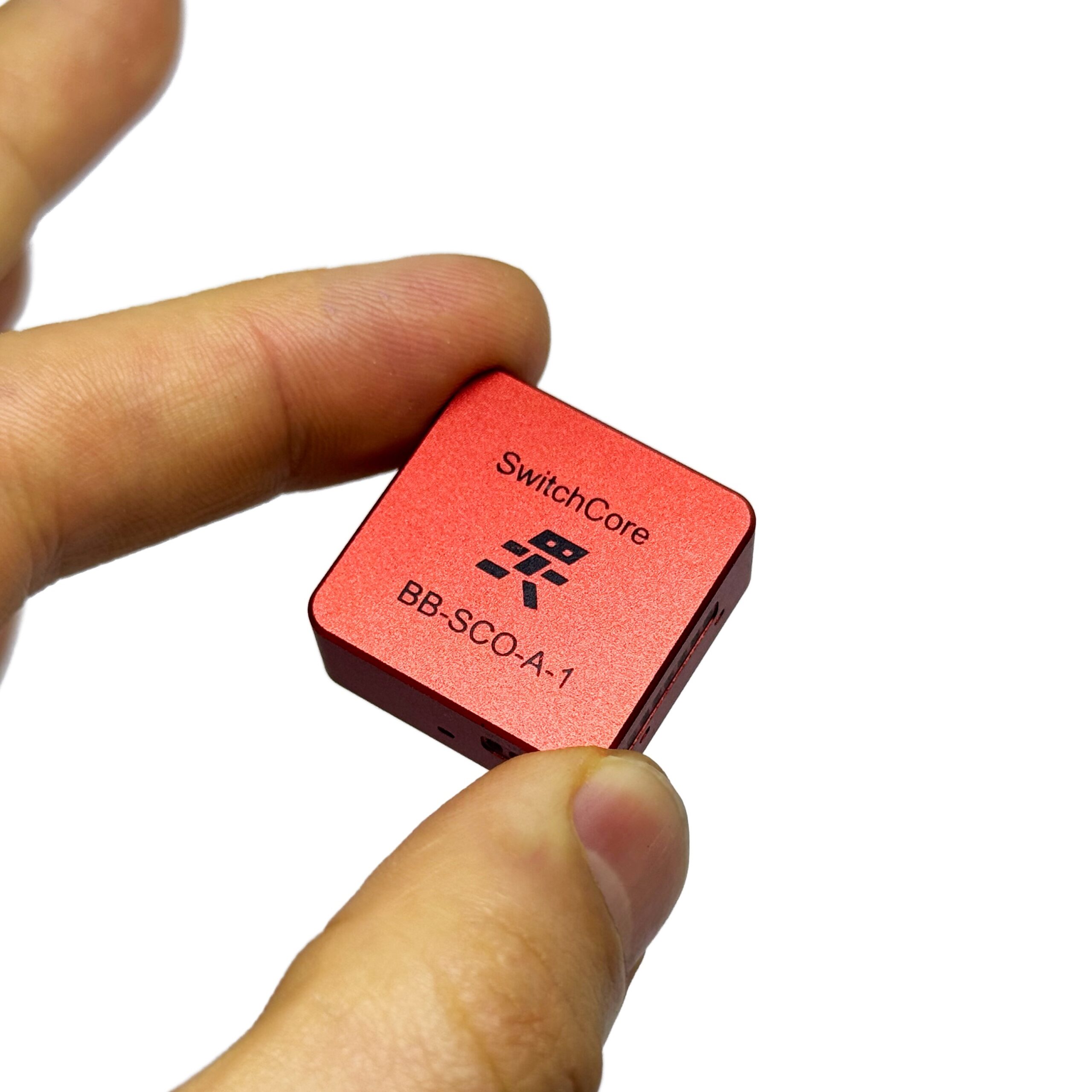
Meet the SwitchCore Ethernet switch/router (Source: BotBlox)
Why do I keep on emphasizing “switch” and “router”? This is because there’s a difference. An Ethernet switch connects devices within a single local network. By comparison, a router conceptually “sits one layer above,” connecting multiple networks and routing traffic between them. Ethernet routers can provide advanced network management and security functions, such as VLAN routing, firewalls, and quality-of-service (QoS) policies, which are beyond the scope of basic Ethernet switches. These advanced services are in growing demand in the unlikeliest of places, such as on a drone, for example, where multiple onboard systems must share secure, high-speed, prioritized data links without interference.
Since even state-of-the-art standard Ethernet chips were too large for this application, Josh turned to a Lattice iCE40 FPGA, which is just 14 × 14 mm, and he wrote the custom Verilog required to implement Ethernet switching functionality. To add Ethernet routing, Josh integrated a tiny STM32 microcontroller, running Zephyr OS on just 0.2W. Meanwhile, Aaron built the firmware and command-line interface from scratch.
In addition to providing both switching and routing functionality, SwitchCore also includes all the Ethernet magnetics. This means designers can drop SwitchCore directly on their board, and they’re “off to the races,” as it were.
Looking back, it’s hard not to marvel at how far we’ve come. In 1980, the mere act of editing a file across a network was worthy of posh sandwiches and press coverage. Today, that same networking magic fits on a board that’s smaller than a postage stamp and costs less than a lunch. From the days when each computer was an island unto itself, the islands have not only connected, but they’ve also learned to drive, dive, fly, and explore the stars. And if Josh and the BotBlox team have anything to say about it, the next great leap in Ethernet may well come from a teeny-tiny package of silicon brilliance.






