



It’s hard to believe that it’s now been nine years since virtual reality (VR) truly went mainstream with the commercial launch of the Oculus Rift. I was at the front of the queue when it arrived. I love VR, but I firmly believe that augmented reality (AR) is the real wave of the future, especially when combined with artificial intelligence (AI).
As an aside (if you’re a regular reader, you’ll have known one was coming), whenever we talk about augmented reality, in which we enhance reality in some way, including graphics and haptics, I like to set the scene by reminding ourselves that AR is actually a subset of mixed reality (MR). MR also encompasses diminished reality (DR), in which elements are removed, such as color from parts of a scene or selected sounds or voices from the sonic environment. Although less well known, MR also includes augmented virtuality (AV), in which real-world artefacts, including audio and video elements, are inserted into an otherwise virtual world.
I currently own a Meta Quest 3, which offers VR with limited AR, but this is only a tempting teaser of what is to come.
As another aside, I’m reminded of the scene in the 1989 supernatural horror film, Warlock, in which a son of Satan (played by Julian Sands) uses a portal to travel from the late 17th century to the modern era, intending to destroy the world. This was an awesome film. If you haven’t seen it, check out the trailer. In a crunchy nutshell, witch-hunter Giles Redferne (played by Richard E. Grant) follows the naughty Warlock through the portal to prevent him from completing the ritual that would unleash the apocalypse. The scene I’m thinking about is when an airline stewardess tries to relieve Giles of his weapon (the shaft and pointer from a weather vane), and he tells her, “You’ll have to pry it from my cold, dead hands” (I feel the same way about my AR headset… and bacon sandwiches).
As one final aside (I simply cannot help myself). I often find myself thinking about the problems involved in building a generation starship; that is, an interstellar ark that travels at sub-light speed and takes hundreds or thousands of years to reach its destination. I’m especially interested in the idea that the ship’s inhabitants are unaware they are on a ship and have forgotten the location of the control room (thinkOrphans of the Sky by Robert Heinlein).
For example, in For the World is Hollow and I Have Touched the Sky, the eighth episode of the third season of Star Trek: The Original Series, the Enterprise encounters an ancient asteroid that turns out to be a generation ship: a hollow world carrying the descendants of a civilization launched centuries earlier. Its inhabitants live under a rigid belief system centered on “the Oracle,” blissfully unaware they’re aboard a starship and on a collision course with a star.
Happily, Spock is a genius, so he has no difficulty mastering the navigation system and correcting the asteroid’s course. This is all the more impressive given that there wasn’t a manual available. Even more impressive is the fact that all the push-button and toggle switches on the navigation system’s control panel still worked. Now that’s some advanced alien technology right there because our Earth-based switches wouldn’t have a chance.
Hmmm. How long would today’s push-button and toggle switches actually last? This is where I start to fall down a rabbit hole of my own devising. Assuming a “shirtsleeves atmosphere” (oxygen, nitrogen, carbon dioxide, and humidity), human habitation (dust, skin oils, and other detritus), and no special preservation measures, a “normal” modern electromechanical push-button/toggle left untouched on a panel will mostly be fighting chemistry (oxidation/corrosion), mechanics (spring and lubricant aging), and contamination (films, dust, bio-gunk).
The exact outcome depends heavily on the materials and the sealing. For our generation starship application, we’ll assume industrial switches boasting the following characteristics:
- Sealed or semi-sealed constructions (IP65–IP68)
- Noble-metal or alloy contacts (gold, silver alloys)
- Robust spring materials (phosphor bronze, beryllium copper, stainless)
- Higher contact forces (to break films and oxides)
- Thicker platings and proper barrier layers (nickel under gold)
- Better plastics (phenolics, glass-filled nylons, thermosets)
After 100 years, a good industrial switch still has a fighting chance of working. After 1,000 years, corrosion becomes cumulative (even sealed switches “breathe” slowly through their seals), elastomers fail (seals shrink and crack), lubricants polymerize or dry, and galvanic interfaces degrade. Some of these switches might still move, but reliable electrical operation is unlikely without refurbishment. At best, we could expect intermittent contact, high resistance, or mechanical seizure.
What about 10,000 years? This is well beyond the design envelope of any “conventional” industrial switch in an oxygenated, inhabited atmosphere. The switch’s likely condition would be: seals gone, plastics embrittled or cracked, metal corrosion products dominating interfaces, contacts no longer cleaning themselves, springs weakened or fractured, and fasteners frozen or chemically welded. Suffice it to say that a functioning industrial switch after 10,000 years would be a museum-grade miracle.
Did you note my use of the “conventional” qualifier in the previous paragraph? Suppose we were talking about “unconventional” switches, such as devices implemented as solid-state ultrasonic sensors, augmented with force sensors, all embedded in the armrests of our spaceship’s command chairs? This would be a horse (or switch) of a different color.
But we digress…
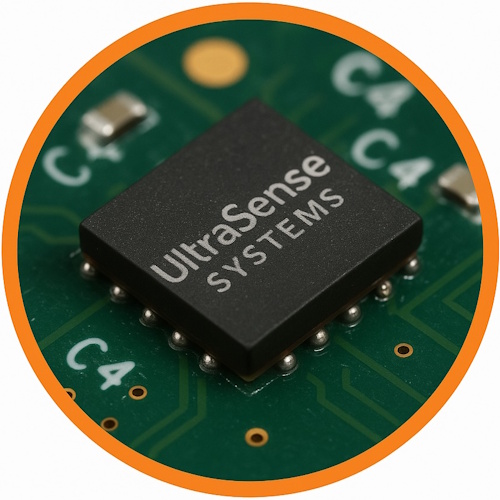
The thing that sparked my rambling ruminations is that I was just chatting with Mo Maghsoudnia, Founder and CEO at UltraSense Systems. A couple of years ago, I wrote about the company’s grain-of-rice-sized ultrasonic-plus-force-sensing switch technology (see Meet the World’s Smallest, Most Integrated 3D Ultrasonic Sensor). Since that time, these switches have been successfully deployed in a variety of applications, including automotive. More recently, Mo tells me, the folks at UltraSense have turned their attention to AR+AI glasses.
It turns out that this is a perfect market for them. Many reports I’ve seen predict that annual revenue for AR+AI (including hardware, software, and services) will grow from tens of billions of dollars in 2025 to hundreds of billions of dollars in 2030.
The primary control methods currently used on AR+AI glasses feature a mix of physical buttons and capacitive touch surfaces. The problem with the current capacitive approach is that it’s touch-only, not press-aware. That is, conventional capacitive sensing detects proximity, not intent. A finger hovering, brushing past, or resting lightly can all look the same electrically. There is no inherent force dimension, which makes it difficult to distinguish between an accidental touch and a deliberate command. This becomes especially problematic on always-on devices like AR glasses, where unintended inputs are common.
Furthermore, capacitive interfaces are notoriously sensitive to sweat, wet hair, humidity, and variations in skin conductivity. In AR+AI glasses, which are worn on the face, near hair and skin, this leads to frequent false positives. This may be tolerated at low volumes, but it becomes unacceptable at scale. And there’s also the fact that capacitive sensing doesn’t work on metal frames. This is unfortunate because metal frames support thinner, more robust, and more fashionable AR+AI glasses than their plastic-only counterparts.
UltraSense’s core insight is that touch alone isn’t enough. Their solution combines multiple sensing modalities (capacitive, ultrasonic, and force) into a single, low-power architecture. CapForce is capacitive sensing with intent awareness. It augments conventional capacitive touch with force sensing, thereby adding a missing dimension: “press.” This results in false-trigger rejection and more reliable UI behavior that works with existing plastic frames.
Meanwhile, UltraForce provides touch and force sensing on multiple materials, including plastic and metal. Instead of relying on electric fields, UltraForce uses ultrasound transmitted through the frame material itself. When a finger touches the surface, ultrasound energy couples into the finger, changing the received signal. UltraForce is material-agnostic—it works with plastics, wood, composites, and metals (magnesium, titanium, aluminum)—it detects both touch and press, and it supports sliders and virtual buttons.

Addressing gesture overload through distributed and diverse interaction zones (Source:UltraSense)
The UltraTouch AR2 is a tiny ASIC (~1.5 x 3mm) that can handle up to 12 capacitive channels, 12 ultrasonic channels, and 4 force-sensing inputs, all with extremely low standby power of < 5 µA. It supports distributed input zones (sliders, buttons, and camera controls placed where users expect them) and a single-finger interaction model (familiar, learnable, smartphone-like behavior).
If these glasses are truly to become the next great personal computing platform—and I personally believe that the AR+AI combo is going to change the way we interface with the world, our systems, and each other—they can’t rely on user interfaces that feel fragile, fiddly, or fundamentally out of place on something you wear on your face.
The controls have to be intuitive, reliable, power-frugal, and robust enough to survive years of daily use, all without requiring users to memorize a choreography of multi-finger gestures.
In this sense, UltraSense’s approach feels less like an incremental tweak and more like a necessary course correction: moving from touch alone to intent-aware interaction, from plastic compromises to metal-friendly designs, and from overloaded touchpads to thoughtfully distributed input zones.
If AR+AI really is destined to guide us through our everyday reality (augmented, diminished, or otherwise), then getting the interface right isn’t a “nice-to have;” it’s mission-critical! And unlike Spock, the rest of us shouldn’t need genius-level intuition to make it all work (soapbox mode off).







I didn’t want to wander off into the weeds in this column (well, no more than I already did), but I feel it behooves me to mention that we could conceive an industrial-plus category of electromechanical switches where sci-fi starts to become plausible.
If we were deliberately designing for millennia, then we could make some design choices that change the equation:
— Hermetic sealing (glass-to-metal, welded metal cans).
— All-metal or ceramic construction.
— Gold or platinum contacts with barrier layers.
— Inert internal atmosphere (argon, nitrogen).
— No organic lubricants
— High contact forces plus wiping.
— Redundant contacts.
— Periodic self-actuation (to break films).
With these measures:
— 100 years: trivial
— 1,000 years: plausible
— 10,000 years: still extremely difficult, but no longer pure fantasy.
Can you suggest any additional design decisions we might take?
But do you really need AR+AI Glasses? I think Henny Youngman said it best:
“My eighty year old grandmother doesn’t even use glasses – Drinks straight from the bottle…”
That sounds just like my dear old mum LOL