




When I was 10 years old, my parents decided I was old enough and responsible enough to catch the bus to school (silly parents). This was in England in the 1960s. We didn’t have dedicated school buses (unlike the bodacious yellow beauties in America); instead, we used standard buses with regular passengers and school kids all jumbled together.
I rode with my friend Jeremy Douglas, who lived up the road. Our parents gave us two “thruppenny bits” each day (small coins worth three pennies)—one for the journey to school and one for the ride back. Most days, so long as it wasn’t raining, instead of catching the bus home, Stephen and I would visit a sweet shop (candy shop) that was just around the corner from our school.
I remember the rows of huge glass jars lining the ancient wooden shelves behind the shopkeeper and on the counter. These mesmerizing containers were filled with brightly colored confectionery of every imaginable shape and size.
There were mint imperials, gobstoppers, humbugs, and aniseed balls. There were sherbet lemons, sour apples, sarsaparilla drops, and pear drops (both red and yellow). There were black jacks (black aniseed flavored chews that were individually wrapped), licorice pipes (with hard sherbet sprinkles on one end), licorice sticks (both hard and soft), Smarties, and fruit pastilles. Best of all, there was something called “Yorkshire Mixture,” which featured an assortment of hard-boiled sweets in a rainbow of bright colors and fun shapes.
After we’d made our selections (“one of these… two of those…”), the shopkeeper would present our treasures to us in small brown paper bags. Then we would take our time strolling back home, happily sucking our sweets while chatting about all the fun things we were planning on doing when we got there.
I’m reminded of the expression, “a kid in a sweet shop” (or “a kid in a candy store,” as they say in America). This is used to describe someone who is extremely happy, excited, and overwhelmed with joy in a situation, often leading to uncontrolled behavior. In turn, this reminds me of the Just William books I used to read around that time.
These stories are set in a country village. They focus on the mischievous and adventurous character William Brown (who was about the same age as me), his dog (a scruffy mongrel called Jumble), and his friends Ginger, Henry, and Douglas. Although William always has good intentions, things invariably go pear-shaped, and he usually manages to end up in trouble. In one of these stories, William is entrusted with minding a sweet shop while the owner steps out for a few hours. What could possibly go wrong?
“But what has any of this to do with high-performance ultra-low-power MCUs running at 0.3V?” I hear you cry. Well, if you can curb your impatience and give me a moment, I’ll tell you. Let’s start by noting there are so many interesting things happening on the technology front these days that it’s hard to keep up. Happily, I’m in an awesome position because companies go out of their way to call me up to tell me about all the cool things—like high-performance ultra-low-power MCUs running at 0.3V—they are doing in the hope that I’ll write about them. I tell you, I’m like a kid in a technology sweet shop. (Ha! And you thought I couldn’t get there.)
Actually, before we leap further into the fray with gusto and abandon (and, as always, aplomb), I’m excited to announce that I’ll be speaking at this year’s Embedded Online Conference, May 11-15, 2026. My talk is billed as A Smorgasbord of Advanced Technologies.
At the time of this writing, a pass that grants access to all 2026 conference sessions and unlimited on-demand access until December 2026 costs only $195 (the price will increase soon). This is a fantastic value when you consider all the incredible speakers and awesome sessions, so you might want to Register NOW before all the good virtual seats are taken. (Shhh… don’t tell anyone, but you can use my promo code MAXFIELD100 to save $100 on your registration.)

More cool speakers and presentations than you can swing a stick at!
Just between you and me, one of the technologies I’ll be talking about is the upcoming Atomiq SoC from the guys and gals at Ambiq, whose claim to fame is ultra-low-power platform solutions that enable edge AI on billions of battery-powered devices. Built on Ambiq’s newly designed 12nm SPOT platform using the TSMC N12e process, Atomiq introduces a new Ultra-Low-Power (ULP) mode engineered to operate near 300mV—the lowest operating voltage in Ambiq’s history.
Let’s take a small step back. If Ambiq has a claim to fame—and they most certainly do—it’s their SPOT (Subthreshold Power Optimized Technology). In a world where most semiconductor companies chase performance by cranking up clock speeds and adding more transistors, Ambiq took a contrarian path: turning the voltage down instead. And I don’t mean a little bit down. I mean waaay down.
Back when Ambiq was happily chugging along in the 0.5 to 0.7volt range, most of the rest of the industry was still operating in what we might call the “comfort zone.” For traditional embedded systems and MCUs, supply voltages of 1.8V and 3.3V were (and still are) extremely common, with some internal cores dropping to around 1.2V in more modern designs. Meanwhile, application processors in smartphones typically ran their cores in the 0.8V to 1.2V range, depending on performance state and process node.
Now, with their forthcoming Atomiq SoC, the chaps and chapesses at Ambiq are taking things to a whole new level: down to around 300 millivolts (0.3V)—the lowest core operating voltage in the company’s history. At this point, we’re skirting the boundary between “engineering” and “black magic.”
What makes this practical, as opposed to a university lab curiosity, is a combination of factors. These include the move to an advanced 12nm FinFET process, which offers faster devices and a steeper subthreshold slope, along with the inherently parallel nature of modern workloads—especially neural networks—and a deeply rethought power management architecture. The latter features a sophisticated multi-rail SIMO regulator that dynamically adapts to workload, process, and temperature. The result is that meaningful workloads, particularly AI inference, can be executed at astonishingly low energy levels.
What’s particularly interesting is that Atomiq isn’t just another MCU with a bit of AI “sprinkled on top.” This is a from-the-ground-up rethink driven by what customers actually want to do next. And what they want to do next is clear: always-on, always-aware, AI-driven devices operating at the edge.
Ambiq saw this coming years ago. Early discussions with customers, dating back to around 2019, revolved around questions like, “What would the perfect neural-network platform look like?” At the time, the answer was effectively, “We’re not quite ready yet.” Now, however, they most certainly are.
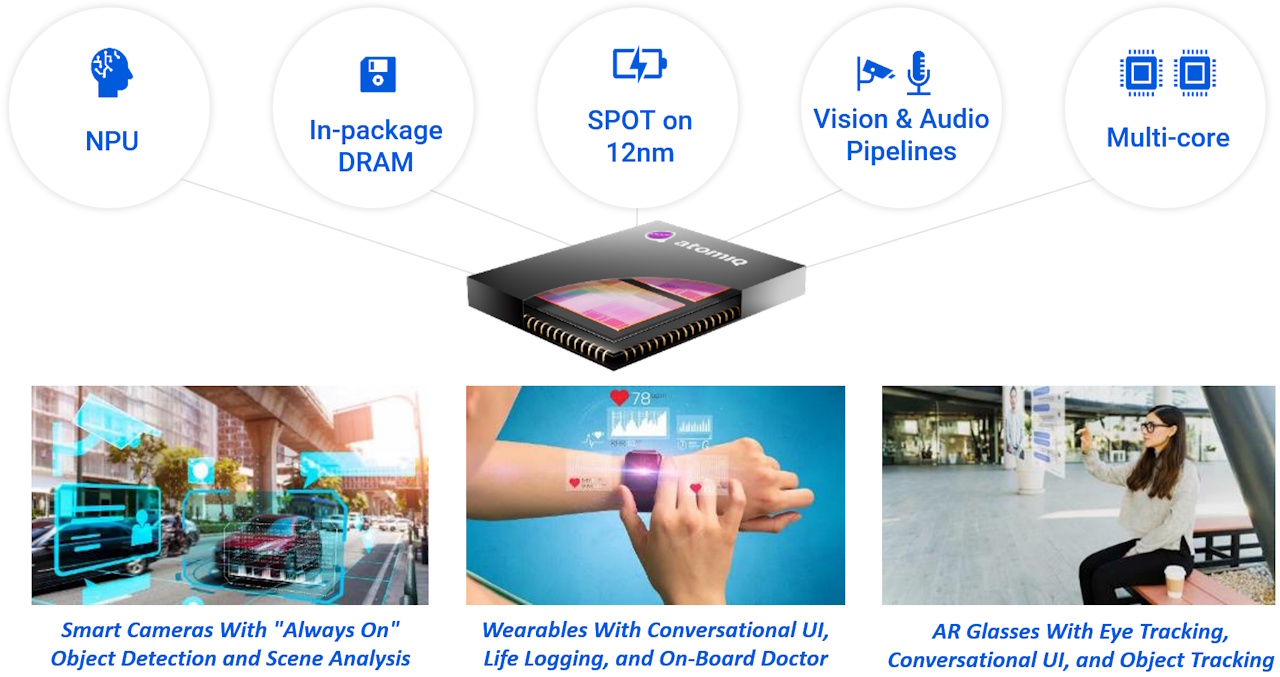
Atomiq is designed to enable increasingly complex edge AI deployments (Source: Ambiq)
Atomiq is Ambiq’s most ambitious device to date, and it shows. At its heart lies an Arm Cortex-M55 CPU serving as the main application processor, paired with an Arm Ethos-U85 NPU dedicated to AI acceleration. The architecture is multicore, with a roadmap that anticipates further scaling in future generations. Memory has also been rethought, with in-package DRAM helping to address bandwidth and energy challenges, while dedicated vision and audio pipelines support increasingly sophisticated sensor-driven applications. Operating frequencies can reach up to around 500MHz, depending on the mode of operation.
The 0.3V-capable NPU is particularly noteworthy, delivering hundreds of multiply-accumulate operations per cycle and substantial AI throughput even at relatively modest clock speeds. This reflects a key philosophical shift: instead of simply running faster, Atomiq runs wider and smarter.
If you really want to understand Atomiq, it helps to delve into the use cases. Ambiq is laser-focused on three major markets: wearables, augmented reality glasses, and battery-powered smart cameras. In wearables, the emphasis is on conversational interfaces, health monitoring, and continuous life logging. In AR glasses, the roadmap includes capabilities such as eye tracking, gesture recognition, and context-aware AI. Meanwhile, smart cameras are evolving toward always-on object detection, scene analysis, and event-driven recording.
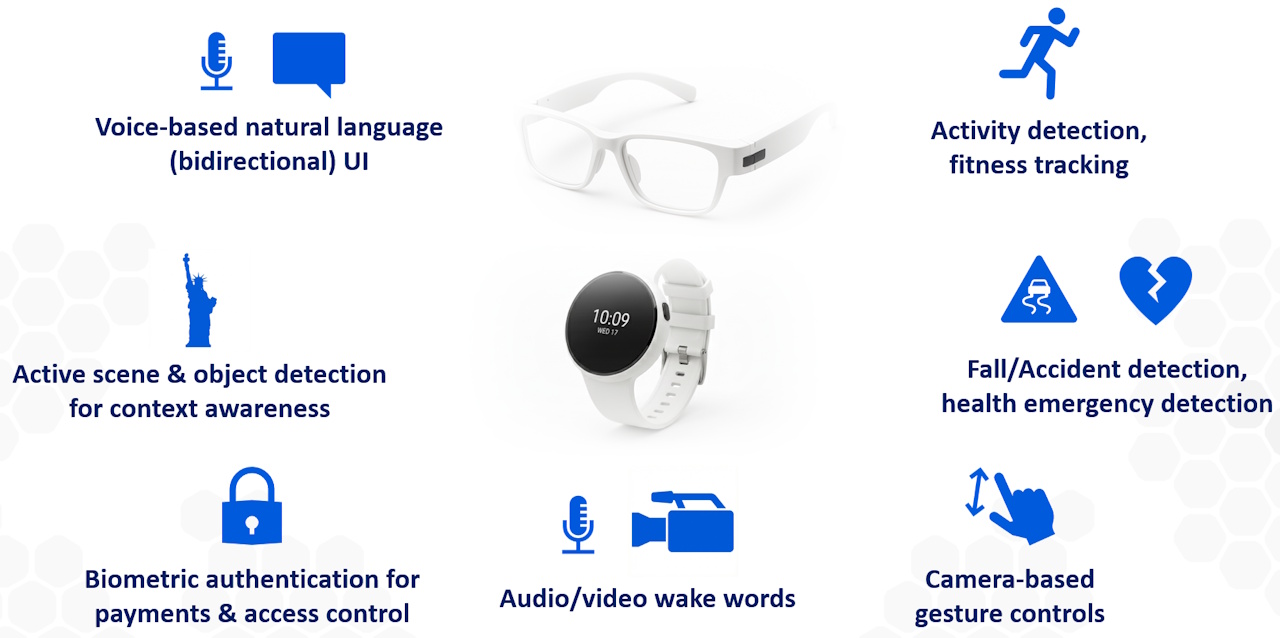
Across all these applications, one theme dominates: always-on, voice-driven natural language interfaces. We’re no longer talking about pressing a button and issuing a command. Instead, these devices continuously listen for wake words, interpret context, and engage in bidirectional natural language interaction—all while operating within the tight energy budgets of battery-powered environments.
One of the most fascinating aspects of Atomiq is how clearly it reflects a broader industry shift. For years, AI has been dominated by the cloud, with its vast computing resources, high power consumption, and inherent latency. The next wave, however, is racing to the edge, where power is limited, latency matters, and privacy is paramount.
Atomiq is explicitly designed for this new reality. By combining SPOT’s ultra-low-voltage operation with highly parallel AI compute and system-level innovations in memory and power management, it enables what has long been promised but rarely delivered: meaningful AI inference on tiny, continuously running, battery-powered devices.
If all of this sounds like being a kid in a technological sweet shop… well… you wouldn’t be entirely wrong. The difference is that this time, instead of gobstoppers and sherbet lemons, we’re feasting on neural networks, multiply-accumulate operations, and millivolts—which are every bit as sweet.






