



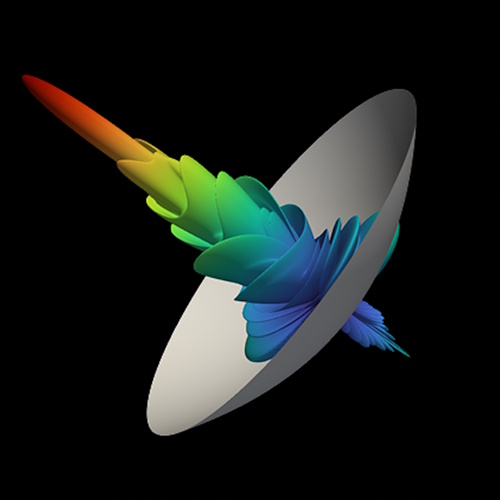
This is going to be a story in three parts. If we’re lucky, they’ll be related, but I’m not making any promises. Let’s start by discussing one of the things I know nothing about. Yes, I know this is a long (and ever-growing) list, but in this case, I’m thinking about the design and analysis of antennas and radar systems.
The closest I’ve ever come to designing an antenna was when I came into proud possession of a battered old black-and-white vacuum-tube and cathode-ray-tube (CRT) television, circa 1971, when I was about 14 years old. I installed this bodacious beauty in my bedroom, and I used a carefully bent metal clothes hanger as my antenna. The resulting images were noisy and low-resolution, but that wasn’t uncommon in those days of yore.
The point is that I really didn’t know what I was doing or why I was doing what I was doing (a state of affairs that’s as true today as it’s ever been). Happily, I wasn’t alone, because antenna design has historically been as much an art as a science.
Maxwell’s equations—first published in a series of papers between 1861 and 1865 and later unified in his 1873 treatise—form the theoretical foundation of classical electromagnetism, classical optics, and electric and magnetic circuit theory, while simultaneously laying the groundwork for modern antenna analysis. Yet, despite this rigorous mathematical underpinning, practical antenna design and analysis long relied heavily on experience, intuition, empirical tuning, and physical prototyping.
Real-world factors—nearby structures, materials, coupling effects, manufacturing tolerances, and the installation environment—often behaved in ways that were difficult or impossible to predict analytically. As a result, prior to the 1960s, successful antenna designers developed a kind of craft knowledge, blending theory with rules of thumb, measurement, and iterative adjustment.
Engineers have been simulating antennas since at least the 1960s, when numerical techniques like the Method of Moments (formalized for EM applications by Roger Harrington in 1968) enabled Maxwell’s equations to be solved on room-sized computers with less memory than today’s wristwatches.
Of course, simulators have increased in capacity and performance over the decades. Having said this, many of the mathematical foundations behind modern electromagnetic solvers date back 30 to 40 years (or more), when memory was scarce, processors were slow, and simplifying assumptions were a practical necessity, which helps explain why so much classical antenna simulation still treats the devices in splendid isolation. Real aircraft, satellites, and vehicles are inconveniently large and electromagnetically messy, so designers have traditionally analyzed tidy antenna elements hovering in computational nothingness, evoking the physicist’s timeless simplification “…assuming a spherical chicken in a perfect vacuum.”
Even today, when we have access to mind-boggling computational capacity enabled by conglomerations of CPUs and GPUs coupled with humongous amounts of memory, it’s not uncommon to simulate antennas and radar systems as standalone entities, without in-depth consideration of the platforms on which they are to be mounted. As a result, platform-related effects are not fully considered until fabrication and integration. The problem is that simulating even relatively simple antennas in isolation can yield unexpected and undesirable real-world results.
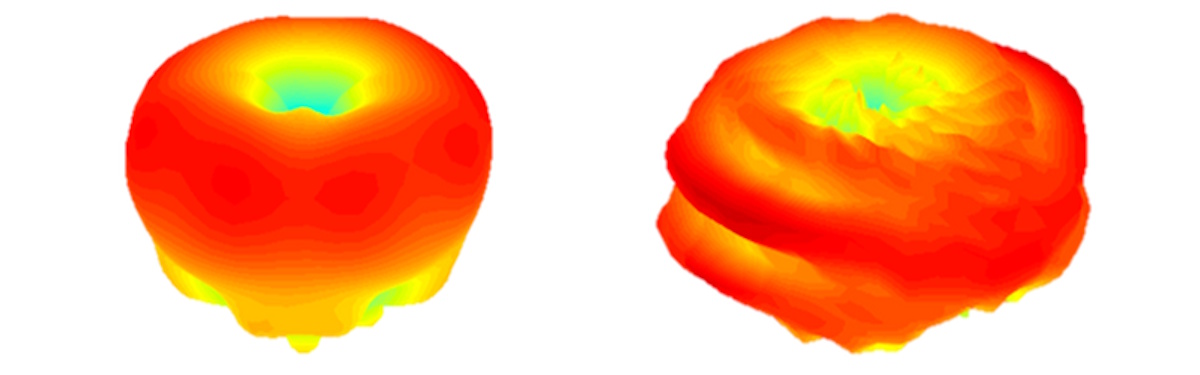
As designed (left) and as installed (right) (Source: Nullspace)
Actually, things are even worse than you think (unless you’re thinking of things being really, really bad), because the same antenna can behave badly in very different ways when mounted on different platforms, like a fixed-wing aircraft and a helicopter, for example.
As an aside, an anechoic chamber is a specially constructed room designed to eliminate wave reflections, allowing measurements to be made in a near-perfect “free-space” environment. Instead of echoes bouncing off walls, floors, and ceilings, surfaces are lined with wave-absorbing structures, creating an environment that mimics an infinite open space.
Audio anechoic chambers are used for sound-related tasks such as loudspeaker testing, microphone calibration, and psychoacoustic research. They are famously known as the quietest places on Earth, often resulting in unique human sensations, such as hearing one’s own heartbeat or feeling one’s blood pressure.
By comparison, electromagnetic anechoic chambers are used for RF/microwave-related tasks such as antenna radiation pattern measurements. Key characteristics of these chambers, which are designed to simulate free-space electromagnetic propagation, are metal shielding to block external radio signals and surfaces covered with RF-absorbing pyramidal foam or ferrite tiles. The big ones are large enough to hold things like vehicles, aircraft, and satellites.
In the image below, a 413th Flight Test Squadron HH-60W (a.k.a. “Whiskey”) is seen hanging in the anechoic chamber at the Joint Preflight Integration of Munitions and Electronic Systems (J-PRIMES) hangar at Eglin Air Force Base, Fla. J-PRIMES provides this environment to facilitate testing air-to-air and air-to-surface munitions and electronics systems on full-scale aircraft and land vehicles prior to open air testing. In this case, the HH-60W spent approximately seven weeks in this chamber undergoing defensive systems testing.
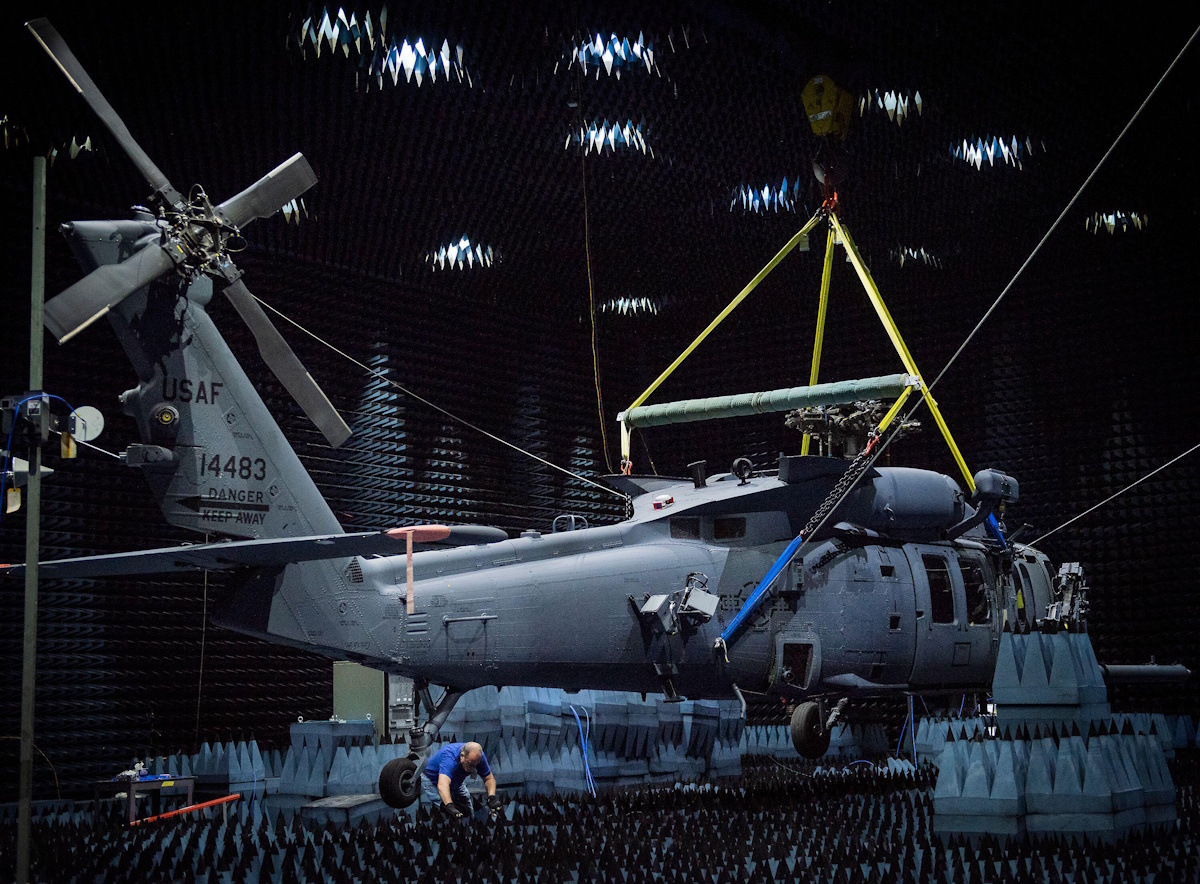
Preparing to test a helicopter in an electromagnetic anechoic chamber (Source: APFootage)
All that we’ve discussed thus far can be boiled down to a simple question: “Do you really want to get to this point (i.e., with your antenna mounted on a helicopter, plane, satellite, or space probe), only to discover that it doesn’t work as planned?”
Now we turn to the second stanza in our column, which we might think of as an interlude (or the “quiet before the storm”). There have been several occasions over the past couple of years when I’ve been made aware of people discovering new mathematical proofs or new ways of doing things.
In 2023, for example, in this article on The Guardian’s website, I first learned that two US high school students, Calcea Johnson and Ne’Kiya Jackson, produced proofs of the Pythagorean Theorem using trigonometric methods, something many believed was extremely difficult or even impossible because trigonometry usually depends on the theorem itself.
A year later, in 2024, I ran across this column in India Today, describing how researchers at the Indian Institute of Science (IISc) discovered a new series representation for π (Pi) while exploring connections in string theory and quantum physics. Interestingly enough, this new formula, which arises from considerations in high-energy particle interactions, closely aligns with the classical series for π originally developed by Madhava of Sangamagrama in the 15th century.
All of this leads us to the third part and the conclusion of this column: the introduction of a new, modern full-wave 3D electromagnetic solver for the design and analysis of antenna and radar systems: Nullspace EM.
“Do we really need YASSS (yet another simulation software solution)?” I hear you cry. Why, yes, we do. I know this because I was just chatting with Masha Petrova, the CEO of Nullspace.
Masha explained that, from the beginning, the Nullspace team set themselves three uncompromising goals: (1) retain full electromagnetic accuracy with no approximations, (2) run dramatically faster than legacy solvers whose numerical foundations date back decades, and (3) expose the entire engine through a deeply integrated Python architecture suitable for automation, optimization, and emerging AI-driven workflows. Those three requirements didn’t merely influence the implementation—they defined the mathematics and software structure from the ground up.
Rather than merely polishing decades-old algorithms and code, Nullspace built its electromagnetic solver around modern numerical methods and modern computing hardware. By combining a contemporary Method-of-Moments formulation, a proprietary matrix-compression technique that preserves full accuracy, and native multi-CPU/multi-GPU acceleration, the company can solve electrically large problems dramatically faster than legacy tools whose mathematical foundations date back to an earlier era of computing.
We’re talking about turning simulations that can consume days, weeks, or months with competitive tools into runs measured in hours while using a fraction of the memory, thereby enabling full-scale simulations to facilitate the design and analysis of antennas and radar across the entire deployment platform.
But wait—there’s more. The result is not merely runtimes that are up to 100X shorter, as wonderful as that may be, but the freedom those runtimes unlock, including the ability to perform AI-driven optimization and even generative, AI-assisted antenna design.
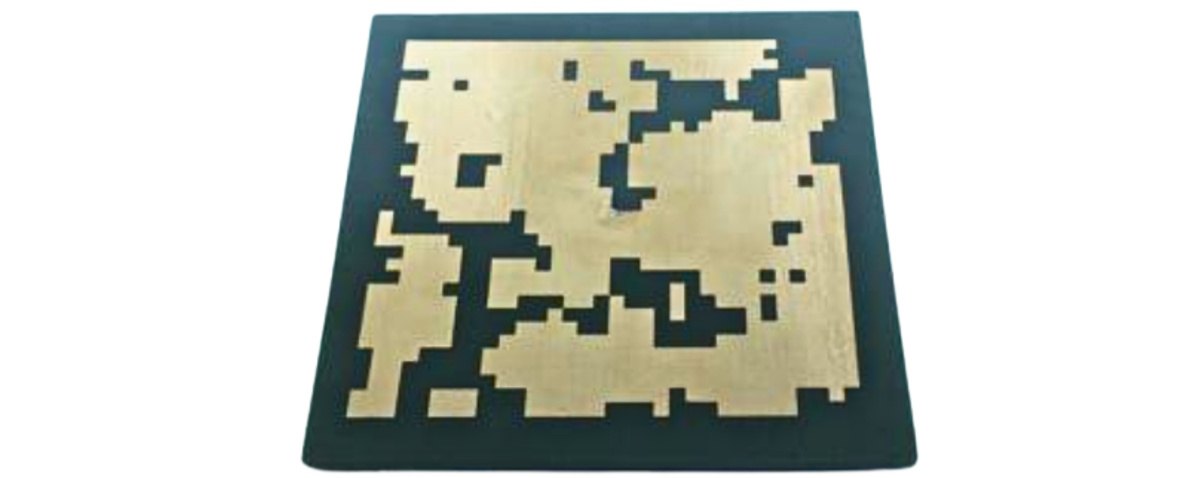
SATCOM antenna generatively designed using Nullspace EM and AI-based
optimization tool integrated by Python API (Source: Nullspace)
Just as interesting as the math is the company’s mindset. Rather than embracing the labyrinthine licensing schemes that have long accompanied high-end engineering software, Nullspace has taken a decidedly un-stodgy approach. Customers can purchase an annual or perpetual license, install it on their own server, and then throw as many CPUs and GPUs at the problem as they wish—without incremental fees, feature gates, or token-counting gymnastics. It’s a refreshingly engineer-friendly model that feels less like negotiating with a software vendor and more like being handed a powerful new tool and told, “Go build something amazing.”
In short, this is not the behavior of an old, staid software incumbent. It’s the energy of a young company whose founders are convinced that long-standing assumptions in electromagnetic simulation are overdue for disruption.
Of course, bold ideas are one thing; real-world validation is another. Despite being a small, young, venture-backed company, Nullspace is already making notable waves (no pun intended). Its customer list includes multiple large defense primes, a major European materials organization working on radar-scattering coatings for electrically large structures, and even a division of the US Air Force. Perhaps most telling of all, the company reports complete customer retention to date—suggesting that once engineers experience dramatically faster, full-fidelity electromagnetic simulation, they are reluctant to return to the slower, more cumbersome tools of the past.
For more than half a century, engineers have relied on electromagnetic simulation tools whose mathematical bones were forged in an earlier age of computing—an era when memory was scarce, processors were slow, and simplifying assumptions were not merely convenient but necessary. Today, however, the world that those tools must model has grown vastly more complex, crowded with antennas, sensors, and RF systems all competing for space, spectrum, and performance.
In addition to running faster, embracing Python and AI, and challenging long-standing licensing conventions, Nullspace is dissolving the boundary between elegant theory and messy reality. Finally, antenna design can progress beyond the “spherical chicken in a perfect vacuum” stage into a future where we can explore the real electromagnetic world with both speed and confidence.






