




As usual, things are moving so fast in AI space (where no one can hear you scream) that I no longer know whether I’m coming or going or doing something else entirely. For example, I’d barely managed to wrap my brain around perception AI when generative AI appeared on the scene, and I was only just getting to grips with generative AI when agentic AI popped up with a metaphorical fanfare of flügelhorns (which is much louder than one might expect for a figurative fanfare).
I think it’s fair to say that most people view the more advanced forms of AI (generative and agentic) as residing only in the cloud. However, as for perception AI before them, generative and agentic AI applications are increasingly making their way to the edge, where the “internet rubber” meets the “real-world road.”
One company that’s devoted to bringing artificial intelligence out of the cloud and into the real world is NXP, whose name, which stands for “Next eXPerience,” is becoming increasingly appropriate as the days go by. Rather than chasing eye-watering TOPS numbers or flaunting data-center bravado, NXP has focused on something far more pragmatic: delivering edge-AI platforms that engineers can deploy in the real world. NXP’s processors, spanning microcontroller units (MCUs), application processors (APs), and heterogeneous SoCs, combine appropriately sized AI acceleration with real- time control, vision, audio, connectivity, and (of particular interest to practicing engineers) long-term availability. This is AI designed for factories, vehicles, machines, and infrastructure, not for press releases.
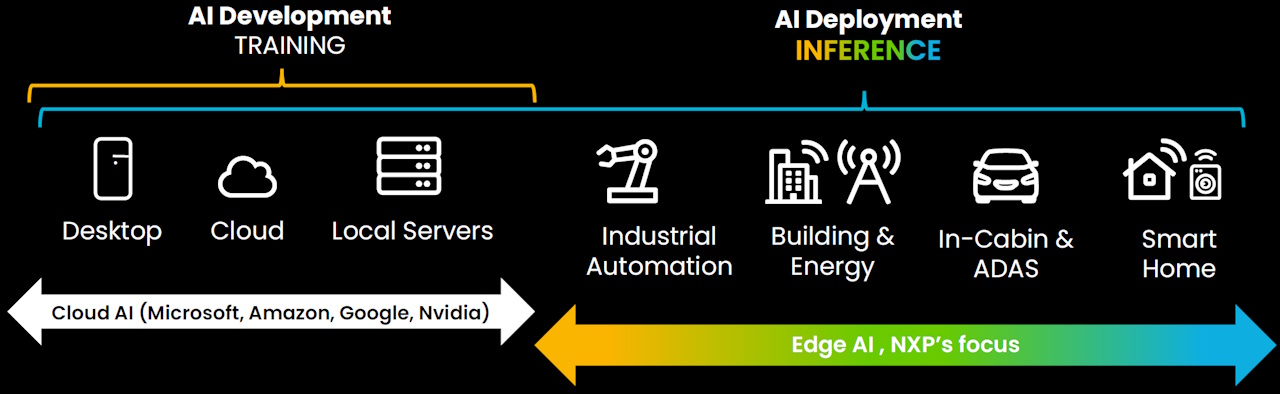
NXP’s focus is AI at the edge (Source: NXP)
Equally important is that NXP has treated edge AI as a full-stack problem. Silicon is paired with mature software, tooling, and frameworks that help developers move from models to products without heroic effort. Add to this NXP’s deep experience in security, safety, and system reliability, and the result is an edge-AI strategy grounded firmly in reality. Against that backdrop, the company’s recent CES announcements around agentic AI don’t feel like a sudden pivot or a buzzword grab. Instead, they feel like the
next logical step in a journey NXP has been methodically preparing for some time.
But I fear we’re getting ahead of ourselves. Let’s quickly set the scene by reminding ourselves that perception AI refers to perceiving what’s happening in the world, including computer vision (object detection and identification) and speech recognition. We can boil this down to “Sense,” as illustrated below.
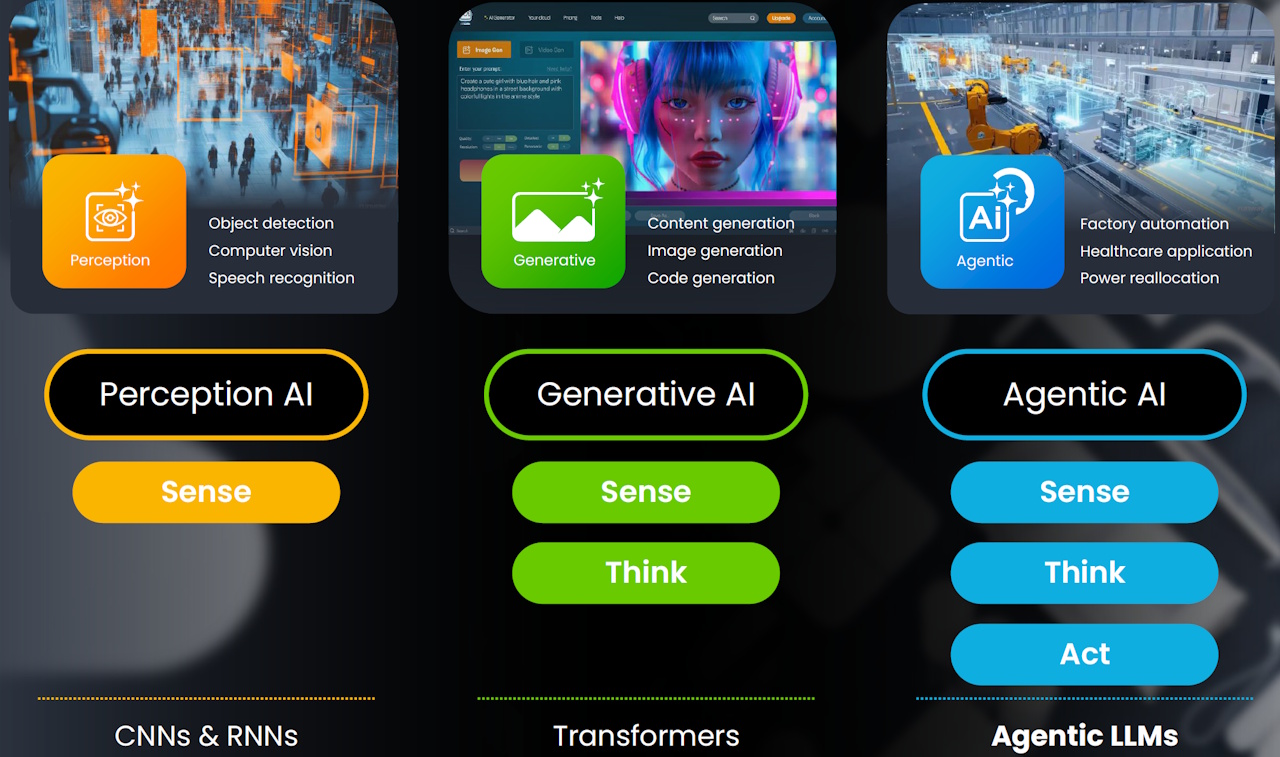
Sense, think, and act (Source: NXP)
NXP was one of the first companies to launch a general-purpose embedded processor with a dedicated AI accelerator, the i.MX 8M Plus in 2020. This allowed developers to switch from traditional computer vision methods to AI for tasks like object detection and classification. Developers no longer had to explicitly define feature extractions, for example. Instead, they could simply say, “This is a cat, and this is a dog,” and the AI would learn what a cat and a dog are and perform feature extraction on its own. At that time, it took around a three-year cycle between having models that couldn’t run
anywhere but in the cloud to having something that was edge-friendly and performant on edge devices.
When generative AI and large language models (LLMs) like ChatGPT emerged, they enabled tasks such as content, image, and code generation. We can think of this as “Sense and Think.” Again, this started in the cloud. The folks at NXP quickly focused on making generative AI relevant and practical at the edge. Having versions of these models that are performant and fit onto an edge profile was about a two-year cycle.
Now we have agentic AI, which we can think of as “Sense, Think, and Act.” In this case, moving from something that was announced and launched in the cloud to making it a reality on the edge took the folks at NXP less than a year.
The reason for my meandering musings is that I was just chatting with Ali Osman Ors, Global Director, AI Technologies and Strategy at NXP. As Ali said regarding agentic AI, “Last year, everybody was talking about it. This year, we were demonstrating it on the CES show floor, showing how you can create and deploy agentic systems that can take autonomous action.”
Before we proceed, let’s briefly review the pre-CES 2026 hardware and software components of NXP’s AI platforms, as illustrated below (note that eIQ stands for “Edge Intelligence”).
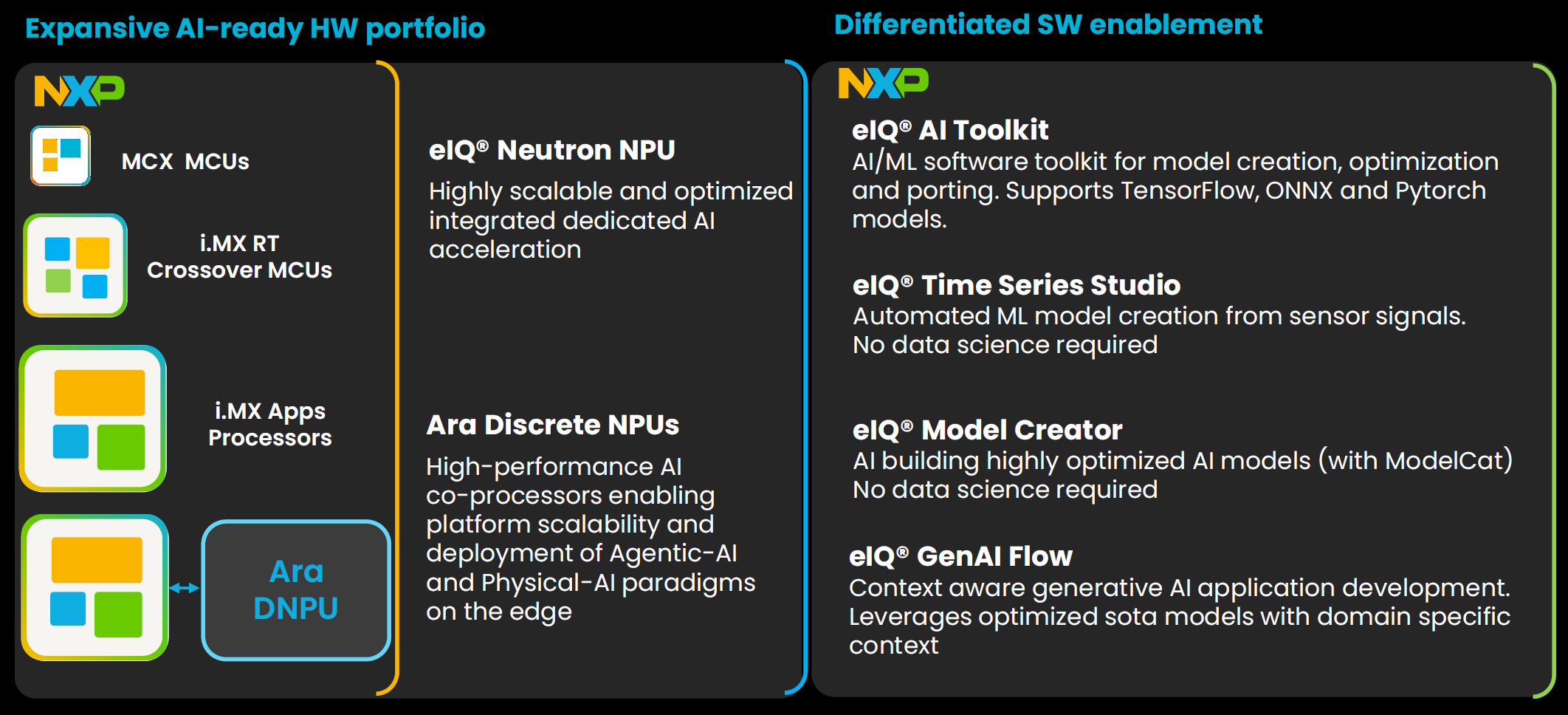
Intelligent edge systems need the latest and greatest in HW, SW, and AI ecosystems (Source: NXP)
Let’s start with NXP’s hardware portfolio, which is growing more extensive by the day. In addition to advanced MCX MCUs, we have even more advanced i.MX RT crossover MCUs. These are very power-efficient but also rich in capabilities and performance (think smart glasses, smart watches, etc.). Next up, we have i.MX APs, which offer heterogeneous compute using more capable multi-core CPUs, GPUs, DSPs, and NPUs.
In each of these categories, NXP offers devices and families with integrated dedicated AI accelerators (NPUs). They initially used an NPU IP from a third party. More recently, they transitioned to using their own internally developed eIQ Neutron NPU core.
But wait, there’s more, because NXP acquired Kinara, along with its awesome Ara AI processors, in October 2025. NXP is currently offering what is now called the Neutron GT NPU in standalone Ara DNPU devices, but it won’t be long before this NPU IP core is available in new families of MCX MCUs, i.MX RT MCUs, and i.MX APs (I don’t know about you, but my brain is wobbling on its gimbals).
On the software side, the eIQ AI Toolkit is NXP’s core software foundation for deploying AI models on edge devices. Its primary role is to take models originally developed for cloud or desktop environments and optimize them for embedded constraints (limited memory, compute, power…).
eIQ Time Series Studio is an automated machine-learning tool focused specifically on time-series data, such as sensor streams, telemetry, and industrial signals. eIQ Model Creator targets a broader class of ML problems beyond time series, providing an automated path from raw data to optimized edge-ready models. And eIQ GenAI Flow extends NXP’s software stack into generative AI, focusing on running transformer- based models efficiently on edge hardware.
But none of this is what I really wanted to talk about.
At CES 2026, NXP stopped short of introducing a standalone “agentic flow” and instead unveiled a more ambitious offering: the eIQ Agentic AI Framework (I find it helps to imagine a roll of drums at this point). As opposed to being a peer to the eIQ GenAI Flow, we can visualize the eIQ Agentic AI Framework as “sitting above” and orchestrating multiple flows, including the eIQ GenAI Flow.
In a crunchy nutshell, the eIQ Agentic AI Framework provides the orchestration layer needed to build autonomous edge systems, coordinating multiple AI models, tools, and actions in real time. It integrates naturally with existing elements of the eIQ stack, including the eIQ GenAI Flow, AI Toolkit, and automated ML tools, enabling perception, reasoning, and control to operate together on-device. The result is not just generative AI at the edge, but agent-driven systems that can sense, decide, and act without relying on continuous cloud connectivity.
Ali described one of the CES demos of the eiQ Agentic AI Framework in action, as illustrated below (MCP stands for Model Context Protocol, an open standard that enables LLMs to communicate with external data sources, applications, and services).
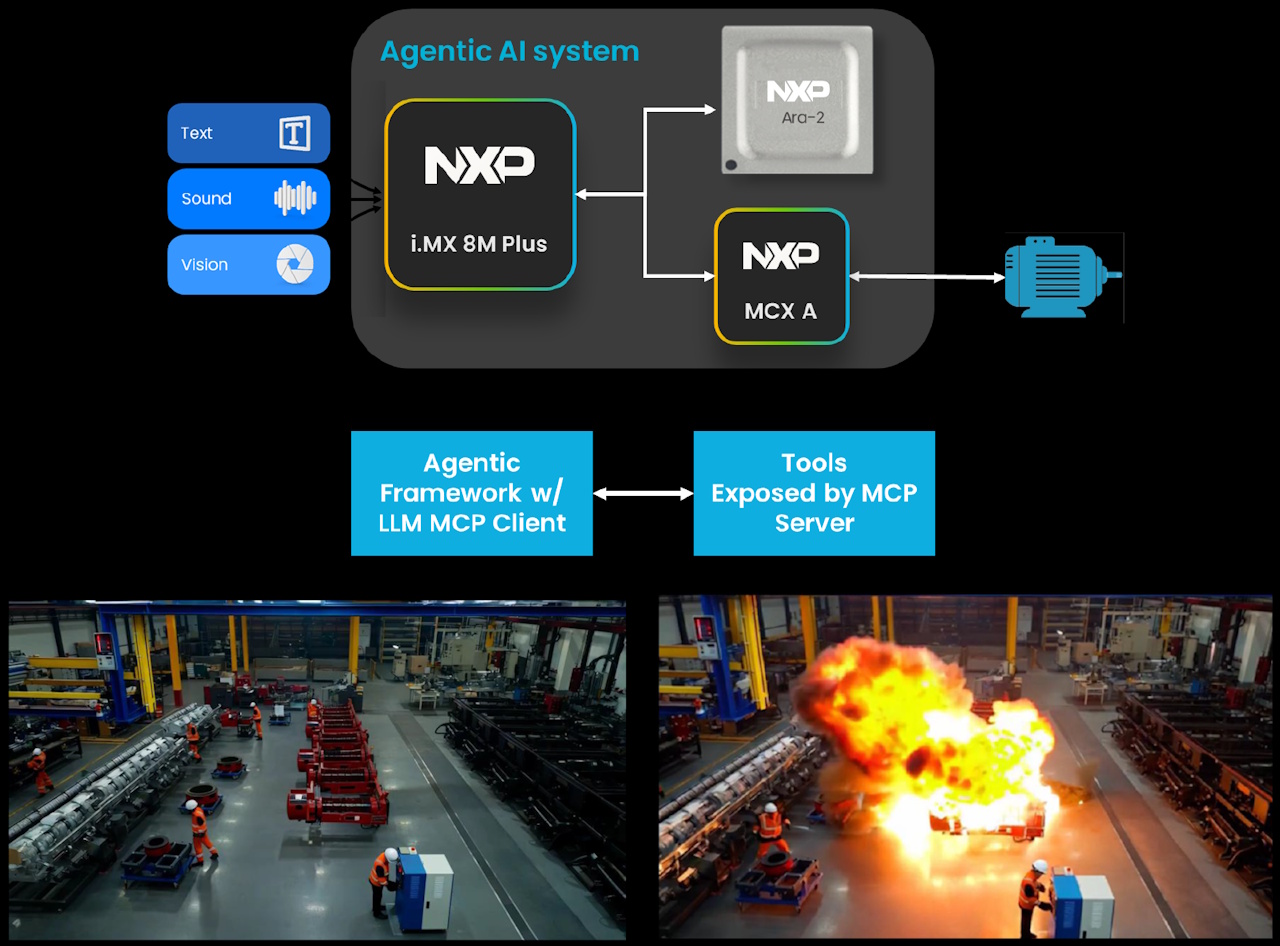
Demonstration of NXP’s eiQ Agentic AI Framework in action (Source: NXP)
In this case, the agentic edge AI system was assembled from heterogeneous devices working together as a single autonomous whole. An i.MX 8M Plus AP acted as the system’s front end, handling multimodal inputs such as video, audio, and text. A discrete Ara-2 NPU ran the large language and vision models, while a small MCX microcontroller handled simple real-time motor control, not as an “intelligent” device in its own right, but as a controllable tool exposed to the AI agent.
The system was given a small set of tools to analyze video scenes, place outbound calls or messages (including via WhatsApp), and activate a motor to emulate responses such as sprinklers or HVAC vents. It was then tasked with monitoring a video feed of an industrial environment and told only this: “If an incident occurs, mitigate its impact and notify a supervisor.”
Crucially, no explicit rules or if-then logic were defined. Instead, vision and language models running on the Ara NPU interpreted the scene, determined whether something constituted “an incident,” and autonomously decided which tools to invoke, triggering physical actions and notifications as needed. The result is a fully on-device, agent- driven system that senses, reasons, and acts without being explicitly programmed for specific scenarios.
I have to admit that I’m amazed at how fast things are moving and how far we’ve come in such a short period of time. One thing that truly “tickled my fancy,” as it were, was when Ari told me that the video stream of “the incident” that was fed to the agentic AI system was itself generated by an AI.
I can’t help thinking how strange and, frankly, implausible all of this would have sounded just a few short years ago. Autonomous systems that watch videos, interpret events, generate code, make decisions, and then take real-world actions, all on-device and without being explicitly programmed for specific scenarios, would once have lived firmly in the realm of science fiction. Today, they’re being demonstrated on a trade-show floor using commercially available hardware and software.
Whether all this excites you, unsettles you, or both, one thing is certain: the edge is no longer just sensing the world; it’s beginning to understand it and act on it. We certainly do live in interesting times (let’s hope they don’t get too interesting).






