feature article
Subscribe Now

Magma’s Titan Supports IPL 1.0 Standard for Interoperable Process Design Kits

SAN JOSE, Calif., May 11, 2010 — Magma® Design Automation Inc. (Nasdaq: LAVA), a provider of chip design software, announced today that the Titan™ Mixed-Signal Platform has been validated to support the interoperability and accuracy requirements of the IPL 1.0 Interoperable Process Design Kit (iPDK) standard. The Interoperable PDK Libraries (IPL) Alliance standard eliminates the need to develop multiple proprietary PDKs and design databases, reducing development costs, shortening delivery schedules and providing designers earlier access to new advanced process technologies across multiple tools. The combination of Titan’s advanced capabilities and compliance with the IPL 1.0 standard provides designers with the fastest path to mixed-signal silicon.

“We have already collaborated with Magma to qualify Titan for the first foundry-specific 65-nm iPDK, which TSMC spearheaded,” said Tom Quan, deputy director of design methodology and service marketing at TSMC. “TSMC is pleased that the Titan Mixed-Signal Platform also meets the iPDK quality standards set in IPL 1.0. This will help us deliver greater choices and advanced design features to our end customers.”

“With the remarkable growth in the number of mixed-signal systems on chip (SoCs), designers need solid analog and digital design solutions that enable them to handle increased complexity while shortening the design cycle,” said Anirudh Devgan, general manager of Magma’s Custom Design Business Unit. “By working with the IPL Alliance to validate the Titan Mixed-Signal Platform for the new IPL 1.0 standard, Magma helps designers accelerate analog and mixed-signal design without compromising accuracy.”

About IPL 1.0

IPL 1.0 is a major accomplishment achieved through the collaboration of IPL Alliance member companies. Semiconductor foundries and integrated device manufacturers (IDMs) can use this standard to build a single iPDK that works with multiple Open Access-based custom design tools, reducing development costs and the need to support vendor-specific PDKs. Electronic design automation (EDA) vendors can use this standard to validate that their tools work with the iPDKs delivered by the foundries and IDMs.  

The Titan Mixed-Signal Solution: Integrating Analog and Digital implementation

Titan is the industry’s first platform to truly integrate analog design, digital implementation and verification. With automated mixed-signal assembly and verification, Titan provides an order-of-magnitude productivity improvement over other analog flows. Titan comprises user-friendly full-custom schematic and layout editors, an analog simulation environment, correct-by-design schematic-driven layout (SDL) and integration with Magma tools for simulation and physical verification. It provides a unified mixed-signal design cockpit with very high capacity and a very fast database access mechanism. Titan’s analog and special-signal shape-based routing provides speed, repeatability and easy implementation of engineering change orders (ECOs). By fully embedding Magma’s Talus® platform, Titan combines the high-level efficiency of Magma’s digital implementation tools with full-custom analog design tools. 

Titan ADX, an integral part of Magma’s Titan mixed-signal design platform, focuses on solving analog/mixed-signal design, optimization and porting challenges. The Titan ADX model-based approach allows circuit optimization and porting in a fraction of the time required by simulation-based techniques. The technology enables product groups to push the design envelope for extreme performance, to center the design for multiple process, voltage and temperature (PVT) corner cases, and to reduce power and jitter. In addition to providing an efficient and predictable method to store analog circuits, Titan ADX reduces design porting time from several weeks to just days. 

About Magma

Magma’s electronic design automation (EDA) software provides the “Fastest Path to Silicon”™  and enables the world’s top chip companies to create high-performance integrated circuits (ICs) for cellular telephones, electronic games, WiFi, MP3 players, digital video, networking and other electronic applications. Magma products are used in IC implementation, analog/mixed-signal design, analysis, physical verification, circuit simulation and characterization. The company maintains headquarters in San Jose, Calif., and offices throughout North America, Europe, Japan, Asia and India. Magma’s stock trades on Nasdaq under the ticker symbol LAVA. Follow Magma on http://www.Twitter.com/MagmaEDA and on Facebook at www.Facebook.com/Magma. Visit Magma Design Automation on the Web at www.magma-da.com.

Leave a Reply

Digi-Key Corporation and RECOM Power, Inc. Sign Global Distribution Agreement

Thief River Falls, Minnesota and Brooklyn, New York (USA) – May 11, 2010 – Electronic components distributor Digi-Key Corporation, recognized by design engineers as having the industry’s broadest selection of electronic components available for immediate shipment, and RECOM Power, Inc. today announced the two companies have entered into an agreement in which Digi-Key will distribute RECOM Power, Inc.’s products to customers worldwide.

RECOM Power, Inc. is a leading supplier of constant current dimmable LED drivers; DC/DC converters; switching regulators; and single, dual, and triple output AC/DC modules. RECOM focuses on providing dedicated product for the industrial controls, lighting, medical, military (COTS), and telecommunications markets. RECOM products are currently available for purchase on Digi-Key’s global websites and will be featured in future print and online catalogs.

“With this global distribution agreement, RECOM Power, Inc.’s reputation as a leading supplier and Digi-Key’s reputation as a leading global distributor have combined to provide our customers with access to more top-quality product from another world-leading supplier,” said Jeff Shafer, Digi-Key’s vice president of interconnect, passive, and electromechanical product. “We believe this new partnership with RECOM will affirm Digi-Key’s commitment to working with the world’s foremost suppliers of electronic components.”

“As RECOM’s extensive portfolio of high-end modular power supplies continues to grow, so does our need for outstanding distribution partners,” said Christoph Wolf, vice president of sales – Americas for RECOM Power, Inc. “It is with pleasure that we are joining forces with Digi-Key to offer our solutions to a broader customer base, while making their selection and use easier for design engineers and our customers worldwide.”

Digi-Key Corporation focuses on providing customers with superior service, which includes product selection and availability, on-time delivery, and responsiveness. Using leading-edge processes and state-of-the-art technologies, Digi-Key serves a global customer base from its 600,000 square foot facility in Thief River Falls, Minnesota, USA.

About Digi-Key

As one of the world’s fastest growing distributors of electronic components, Digi-Key Corporation has earned its reputation as an industry leader through its total commitment to service and performance. Digi-Key is a full-service provider of both prototype/design and production quantities of electronic components, offering more than 1.5 million products from over 440 quality name-brand manufacturers. A testament to Digi-Key’s unparalleled commitment to service, North American design engineers have ranked Digi-Key #1 for Overall Performance for 18 consecutive years (EE Times Distribution Study/August 2009). Additional information and access to Digi-Key’s broad product offering is available at www.digikey.com.

About RECOM Power, Inc.

RECOM is an internationally leading and multiple certified German manufacturer for DC/DC converters, LED Drivers (constant current), Switching Regulators and AC/DC modules. The main focus of RECOM is the low power DC/DC range from 0.25W~100W. In this range, RECOM, with their state-of-the art products, is one of the leading manufacturers worldwide. RECOM is specialized in making modular converters smaller and more efficient. This includes high isolations for medical applications. Additional company and product information is available at www.recom-power.com.

Leave a Reply

Software Developers Get New High Performance Computing C-to-FPGA Tools

Kirkland, WA – May 11, 2010 – DRC Computer and Impulse Accelerated Technologies today announced that the Impulse C™-to-FPGA tools have been integrated with the DRC Accelium™ coprocessor card, enabling software engineers to fully access hardware acceleration using familiar C programming methods. This integration provides C-language control of I/O, memory, streams and signals at the hardware level, allowing applications to leverage the high parallelism possible in FPGAs for higher performance.

FPGAs are recognized as powerful accelerators for non-sequential algorithms, and have been successfully deployed by engineering teams ranging from defense and aerospace, including NASA, to financial computing. For complex, highly algorithmic applications, automated tools such as Impulse C improve programming productivity. Using the Impulse tools, applications written in C can be implemented as multiple streaming processes in FPGAs. Using the DRC Computer Accelium coprocessor card, application performance and throughput can increase by 10X, 100X, or more. Typical applications include image analysis, data mining and encryption.

“We are happy to see our technology made more accessible to software developers,” said Lawrence Laurich, President of DRC. “The work Impulse has done to abstract away the low-level hardware details, plus their ability to automatically parallelize C code, has brought hardware capability to the much larger population of software developers.”

“The DRC Accelium platform integrates many of the components our software oriented users need to deploy dozens to thousands of accelerated systems,” said Brian Durwood, CEO of Impulse. “By providing a well integrated, tested and expandable platform to industry, DRC takes much of the risk out of high performance computing.”

The integration is the work of Synective Labs, a long-standing partner to DRC and Impulse, specializing in hardware acceleration solutions. The Synective team developed robust links from ANSI C to all the key hardware features of the DRC boards. This enables DRC users to write or import C code and compile all the way to hardware, without having to become hardware experts.

Migration to future FPGA-based accelerators also becomes easier. Most if not all of the design code is abstracted from hardware such that the design and test code can be easily retargeted to new platforms as they emerge. Many design teams are finding that their investment in software development is eclipsing their investment in hardware development, increasing the pressure to select methodologies that lend themselves best to quickly deploying future platforms as they emerge.

About DRC Computer

DRC Computer Corporation (www.drccomputer.com), a Security First Corporation (www.securityfirstcorp.com) company, is the leading innovator of coprocessors addressing the needs of time-critical, data-intense applications in the defense, finance and energy industries, security environments, web companies, and biomedical markets. DRC’s Accelium™ coprocessor products accelerate applications up to 100 times and more. Cofounded in 2004 by Larry Laurich and Steve Casselman, DRC is headquartered in Sunnyvale, California. For more information, visit www.drccomputer.com.

About Synective Labs

Synective Labs is an expert in hardware acceleration, headquartered in Sweden, providing solutions to customers worldwide. Synective enables customers to make efficient use of acceleration technology within their applications, often reaching speed-ups of one or two magnitudes. With their experience in image processing, automotive, radar and telecommunication, Synective has a broad range of customers as a development partner and solution provider.

About Impulse

Impulse Accelerated Technologies provides C-to-FPGA tools, training and custom solutions for applications that include vision systems, financial feed handlers, encryption systems and database grid accelerators. Impulse C enables engineers to import or create ANSI C for FPGA based acceleration. Impulse C is used at over half of the automotive suppliers, eight of the top ten government contractors, most US government agencies and hundreds of R&D labs worldwide.www.ImpulseC.com

Leave a Reply

featured blogs
Dec 8, 2025
If you're yearning for a project that reconnects you with the roots of our digital age, grab a soldering iron and prepare to party like it's 1979!...

featured news

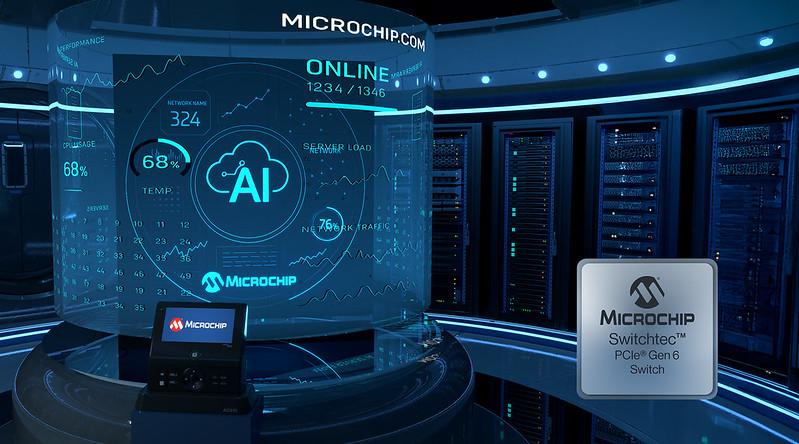
Microchip Unveils First 3 nm PCIe® Gen 6 Switch to Power Modern AI Infrastructure

Sponsored by Microchip

AI systems are starving for bandwidth. Microchip’s 3 nm Switchtec™ Gen 6 PCIe® switches deliver up to 160 lanes, lower power, and CNSA-compliant security—built for the future of AI and cloud infrastructure.

Click here to read more

featured chalk talk

Data Center Solutions
Sponsored by Mouser Electronics and Microchip
In this episode of Chalk Talk, Josue Navarro from Microchip Technologies and Amelia Dalton investigate the biggest challenges of AI servers and the benefits that power modules can bring to these types of designs. They also explore the roles that energy efficiency, power density, thermal management, and security play in the AI server applications and how you can take advantage of Microchip solutions for your next AI server design.
Dec 8, 2025
6,876 views